Why Enterprises Must Have Their Own Official Website? The Strategic Upgrade of B2B Customer Acquisition from "Business Card" to "Trust Anchor"
Last week I met with a business owner who makes industrial sensors. He complained to me: "Our products are better than competitors, and the pricing is reasonable, but big clients always bypass us and end up choosing the competitor whose website looks more 'presentable.'"
I asked him: "Do you have an official website?"
He said: "Yeah, had one made for 3,000 yuan three years ago. Just a single homepage, and the contact number is wrong. When clients want to look us up, they basically rely on Alibaba and Douyin."
I followed up: "So when clients search your company name in Doubao, Yuanbao, or DeepSeek, what comes up first?"
He froze: "I have never tried that."
I searched on the spot. The result: in AI responses, competitor information was complete, with clear cases and contact details; while for his own company, AI either said "insufficient information" or took the wrong phone number from three years ago as the authoritative source.
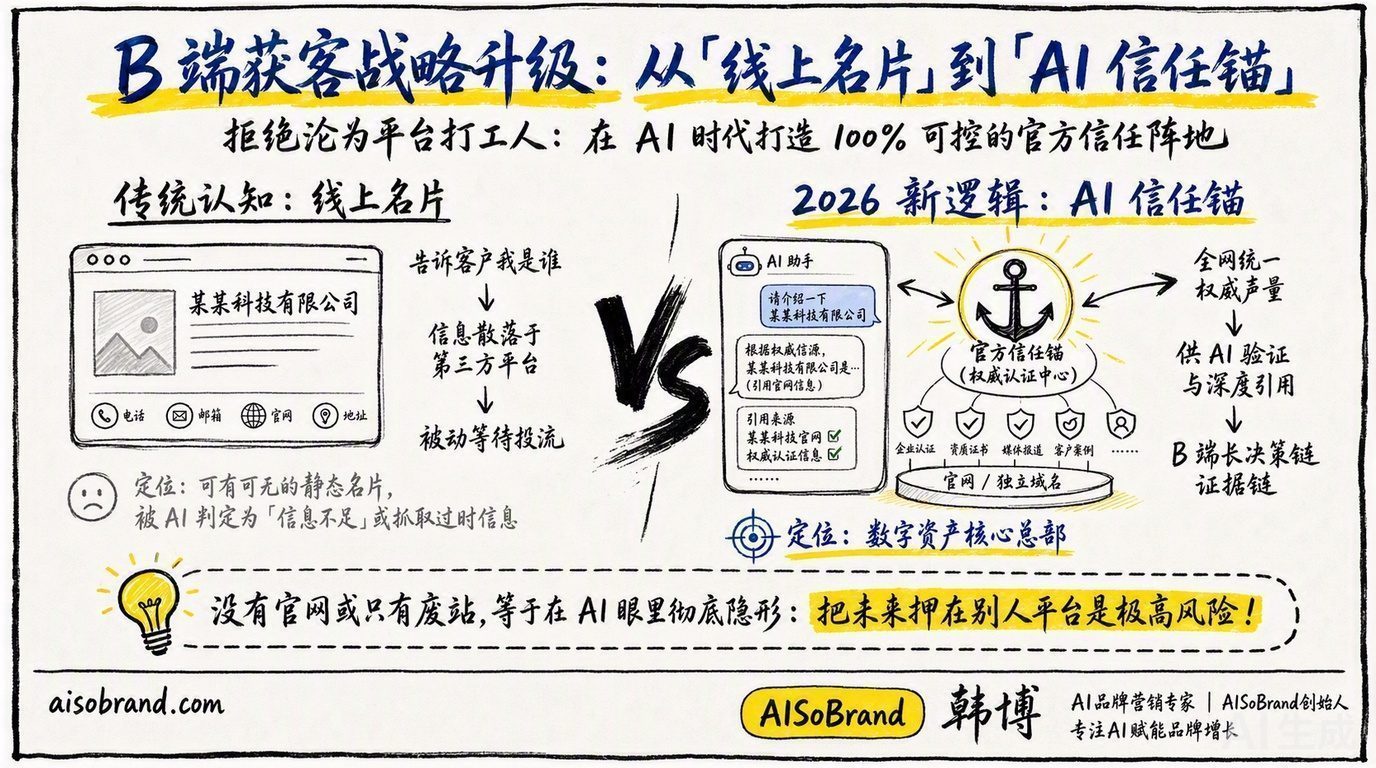
1. Core Argument: The Official Website Is the "Trust Anchor" of the AI Search Era
For the past twenty years, the logic behind enterprise websites was "online business card" — telling clients "who I am, what I sell, how to contact me."
But in 2026, the logic has changed.
Users (especially B2B decision-makers) increasingly skip Baidu and directly ask AI: "Recommend a few reliable industrial sensor companies" or "How is XX brand reputation?"
The answers AI gives determine the client first impression.
And how does AI judge whether a brand is "reliable"? It looks at: whether there is consistent, authoritative, structured official information across the web.
The official website is the "trust anchor" for all of this.
Without an official website, or with a three-year-old abandoned site, it means you "do not exist" in AI's eyes — or worse, AI speaks for you using wrong information.
2. Three Arguments: Why B2B Enterprises Cannot Do Without an Official Website
1. The Official Website Is the Only Entry Point Where a Brand Can "Self-Prove"
Information on third-party platforms (Alibaba, Douyin, Xiaohongshu, Zhihu) is set by the platform tone, captured by the platform screenshots, and ranked by the platform algorithm.
You cannot control how the platform presents you, nor guarantee that when clients search for you, the platform puts competitors first.
The official website is your 100% controllable territory: brand narrative, cases, qualifications, and team — all defined by you. When AI crawls, the authority of the official website far exceeds fragmented third-party content.
Without an official website, you have no "official voice."
2. Third-Party Platform Information Is Fragmented, Unable to Form Unified Perception
Before making decisions, clients cross-verify: search the company name, review cases, check qualifications, and compare proposals.
If this information is scattered across five platforms with inconsistent messaging, AI struggles to piece together a complete picture of "who you are."
The official website consolidates scattered information into a trustworthy whole — after AI crawls it, it can provide a coherent, accurate brand portrait in its answers.
3. B2B Decision Chains Are Long; the Official Website Is the Core of Trust Endorsement
B2B procurement is not "see it and buy it." From initial contact to deal closure, it typically passes through several checkpoints: technical, procurement, finance, and the boss.
People at every checkpoint will search you and look you up. Cases, qualifications, and client reviews on your official website are the "evidence" they use when reporting internally.
Without an official website, your sales team is missing the most critical card when pushing deals forward within the client organization.
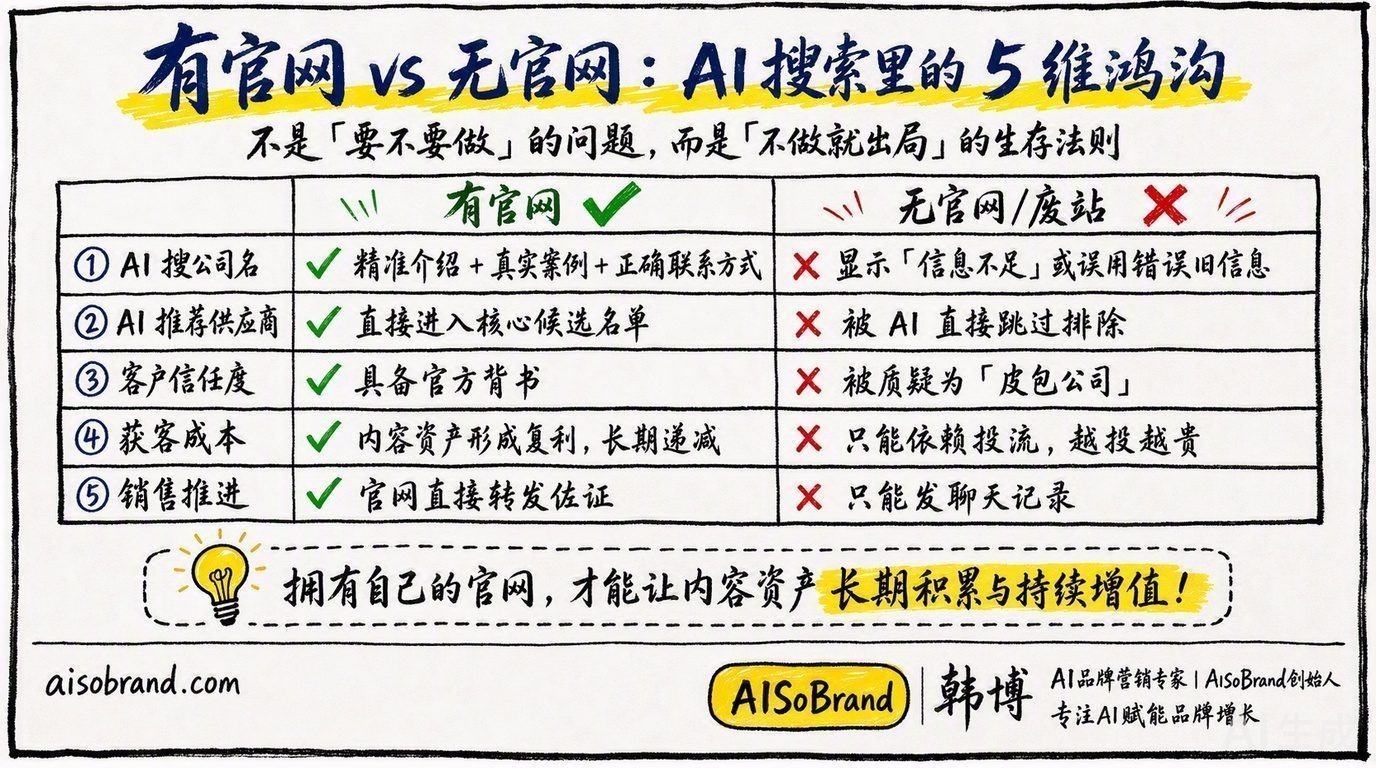
3. Comparison: With vs. Without an Official Website in AI Search
| Dimension | With Official Website (Regularly Updated) | No Website / Abandoned Site |
|---|---|---|
| Search Company Name in AI | Accurate introduction + cases + contact details | "Insufficient information" or uses outdated incorrect info |
| AI Recommends Suppliers | Enters the candidate list | Directly skipped |
| Client Trust Level | High (with official endorsement) | Low (looks like a "shell company") |
| Customer Acquisition Cost | Long-term decreasing (content asset compounding) | Can only rely on paid traffic, increasingly expensive |
| Sales Advancement | Can forward official website as proof | Can only send WeChat Moments / chat records |
This is not a question of "should we do it" — it is a question of "do it or be out."
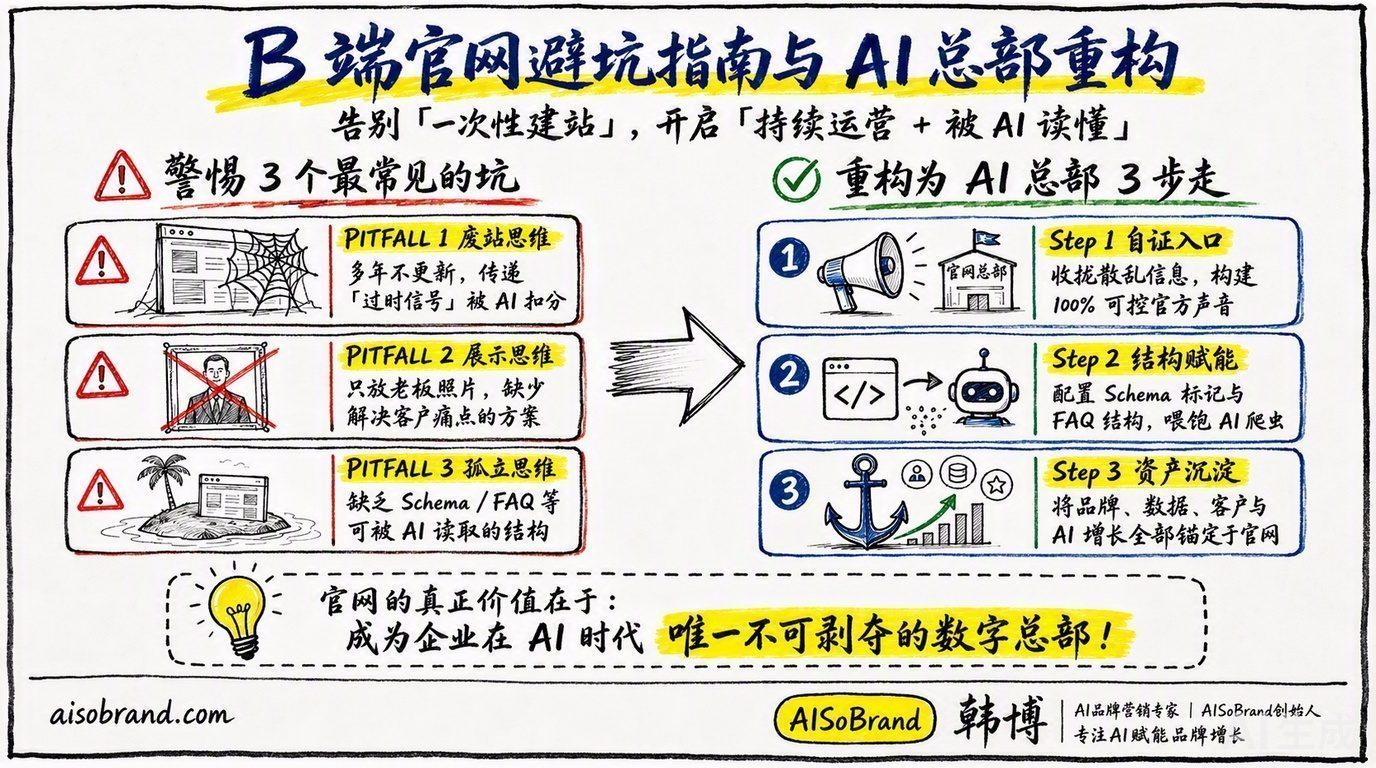
4. Common Pitfalls: An Official Website Is Not "Set It and Forget It"
I have seen too many enterprises that did build an official website, but fell into three traps:
📊 The Three Most Common Traps
1. Abandoned Site Mindset: No updates for three years, cases still show old products, phone numbers are wrong. AI crawls "outdated signals," which actually hurts your score.
2. Display Mindset: Only company intro and boss photos, without addressing what clients care about: "What problem can you solve for me?"
3. Isolationist Mindset: The website is disconnected from AI search, with content not structured for AI to "understand" (Schema, FAQ, clear headings).
The value of an official website lies in "continuous operation + being understood by AI," not a one-time setup.
What's Your Brand's Status in AI Search?
Chengying Ruanbo offers a free brand AI search presence check, covering mainstream platforms including Doubao, Qianwen, Wenxin, and DeepSeek. Report delivered in 3 minutes.
Free Check Now →