In the AI Era, Every Corporate Website Needs a Redo
Have you ever wondered: your company clearly has a website, so why — when a customer asks AI "which company is best in XX industry" or "how to choose XX product" — does AI never mention you in its answer?
It is not that you lack a website. Today, the vast majority of companies have one. The problem is — your website was built for "humans" to see, not for "AI" to read. And in 2026, users increasingly no longer "search" — they "ask" directly. They ask Doubao, Yuanbao, Tongyi, DeepSeek, and ChatGPT.
Every answer AI gives is filtering customers on your behalf. If your website is not in AI's "reference answers," you effectively do not exist in AI's world.
This is not fear-mongering — it is a fact happening right now.

1. The Traffic Gateway Has Shifted
For the past twenty years, the digital marketing logic for companies was simple: build a website, do SEO, make sure Baidu and Google can find you, users search keywords and click through, and deals are closed.
That logic is now collapsing.
User behavior has changed. Young people increasingly skip search engines when buying products or finding services. They go straight to the AI chat box and ask: "Recommend a reliable XX company" or "Which is better, XX or XX?" AI delivers a conclusive answer in seconds, complete with a few company names. Users do not even look at the search results page — they just adopt AI's conclusion.
What does this mean? It means no matter how beautiful your website is or how thoroughly you have done SEO, if users no longer "search," your traffic gateway is cut off. The new traffic gateway is AI's answer box.
And AI's answer box does not care how your website looks — it only checks one thing: whether it can confirm from publicly available information that "you are who you say you are, you are trustworthy, and you deserve to be recommended."
2. Why AI "Cannot See" Your Website
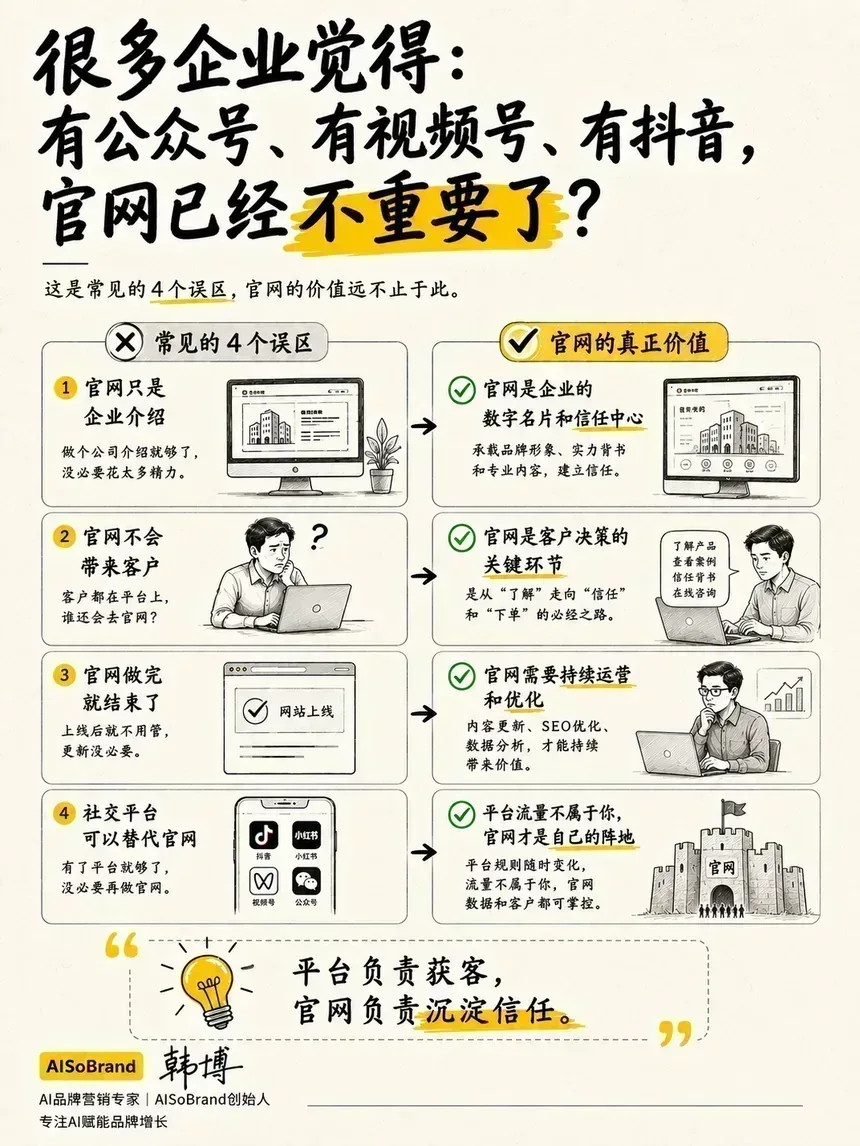
For AI, the vast majority of corporate websites are "noise," not "signal." There are five specific hard issues:
1. Content Is Written for "Humans," Not for "AI"
Your website is full of marketing jargon, flashy banners, and floating animations, but AI crawlers cannot extract "who you are, what you do, and what credentials you have." AI needs clear facts: company name, founding date, main business, core data, client case studies, and contact information. You may have all of this on your website, but scattered across flashy pages, AI cannot read the structure.
2. No Structured Data
Modern AI and search engines rely on structured data (schema.org, JSON-LD) to understand pages. Most corporate websites either lack it entirely or have only a partial implementation. The result: AI knows the page exists, but is not sure what it is about or who you are.
3. Everything Is JS-Rendered — Crawlers Get Nothing
Many websites, for the sake of visual appeal, render entire pages with JavaScript, generating main content only in the user's browser. AI crawlers are not like real browsers — what they capture is often an empty skeleton. You think you have content; AI sees emptiness.
4. No "Cited" Authority Signals
When AI recommends a company, it relies on "many people saying good things about you." If your brand only appears on your own website, with no news, encyclopedias, industry sites, or third-party reviews mentioning you, AI has no evidence to believe you are worth recommending. An isolated website is an island — AI will not treat it as an authoritative source.
5. Content Lacks "Citable" Value
When AI generates answers, it cites content that has clear conclusions, data, and viewpoints. If your website is full of "we are committed to becoming an industry-leading..." — correct but empty platitudes — why would AI cite you? It would rather cite a third-party article with specific data and methodology.

3. "Redo" Does Not Mean Starting Over — It Means Upgrading the Underlying Logic
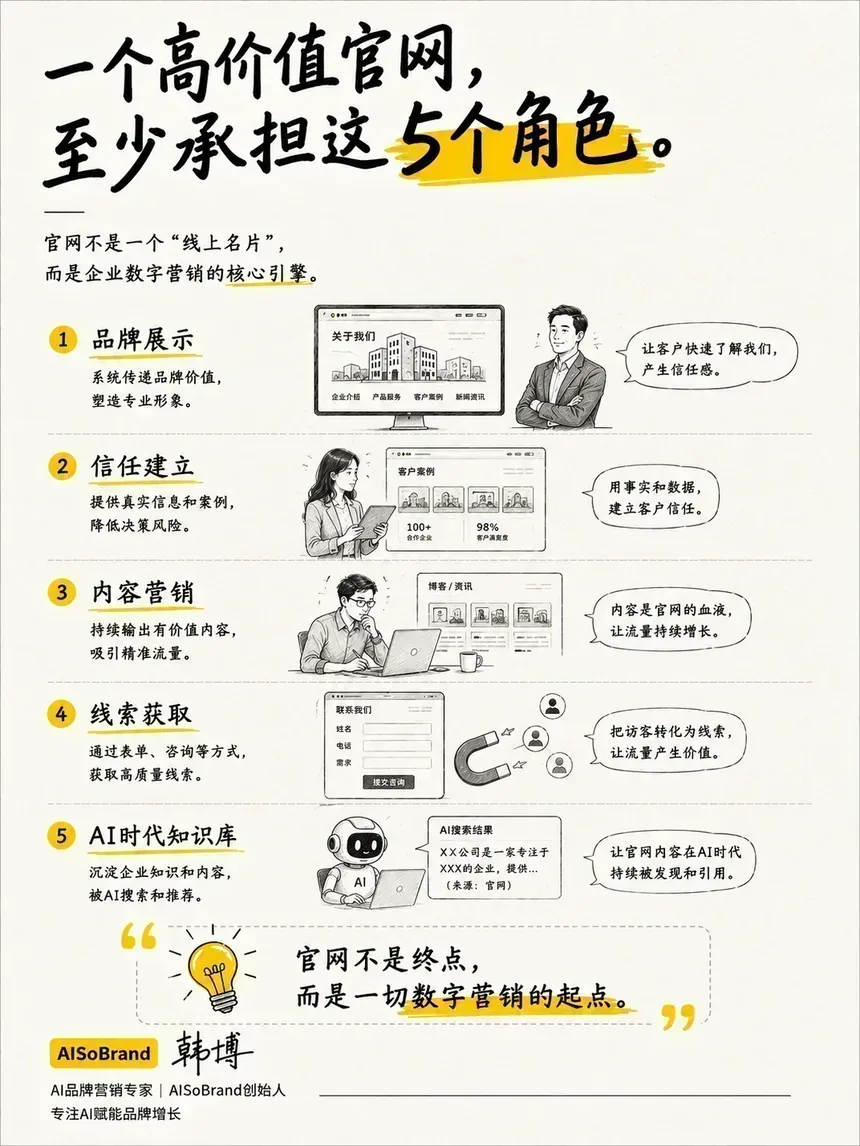
When I say "every corporate website needs a redo," I do not mean tearing down the design and starting over. I mean upgrading the underlying logic of your website from "built for humans" to "built for humans + readable by AI."
Specifically, four new standards:
Standard 1: Dual-Mode Content
Every page should have both a complete visual experience for humans and a "fact layer" for AI — clear company profiles, credentials, data, and case studies, annotated with structured data. Make it look professional to humans and let AI confirm who you are at a glance.
Standard 2: Citable Content Assets
Proactively produce content with viewpoints, data, and methodology (industry reports, white papers, case study breakdowns). This content will be cited by AI as a "trusted source," and your brand will enter AI's answer database.
Standard 3: Build External Authority Signals
Get your brand featured in news, industry media, encyclopedias, and niche communities. AI needs to see "multiple parties are talking about you" before adding you to the recommendation list. Your website is the home field, but authority is built externally.
Standard 4: Continuous AI-Visible Operations
GEO (Generative Engine Optimization) is not a one-time job. AI's training data and answers are continuously updated, so you need to keep monitoring: How does AI describe you now? Is it accurate when it mentions you? Have competitors taken your place? Correct deviations immediately and fill content gaps as they appear.
Conclusion
Every corporate website needs a redo — not redesigning the visuals, but rebuilding the ability to "be seen by AI."
You do not need to tear down your existing website. What you need is: make AI understand you, let external signals trust you, and let content assets speak for you.
Doing this early is cheaper than doing it late.
How is your brand performing in AI search?
Chengying Ruanbo offers a free brand AI search presence check, covering major platforms including Doubao, Qianwen, Wenxin, and DeepSeek. Report ready in 3 minutes.
Get Free Diagnosis →