AI Fake Digital Transformation: Why Do Your Digitalization Projects Always Fail?
1. Introduction: Digitalization Is Not About Buying Systems, It's About Changing How You Work
Last month, I met with a restaurant chain owner. He told me: "I spent 3 million on digitalization — implemented ERP, CRM, POS, and a membership system — but it feels useless. Employees still use Excel, data is still scattered, and decisions are still made by gut feeling."
I asked him: "Do your employees actually use the ERP?"
He hesitated: "Use... well, the finance department uses it."
"What about the stores?"
"The stores... they say it's not user-friendly, so they still use Excel."
I smiled. This is classic "fake digitalization" — it looks like digitalization, but in reality, they're still working the old way.
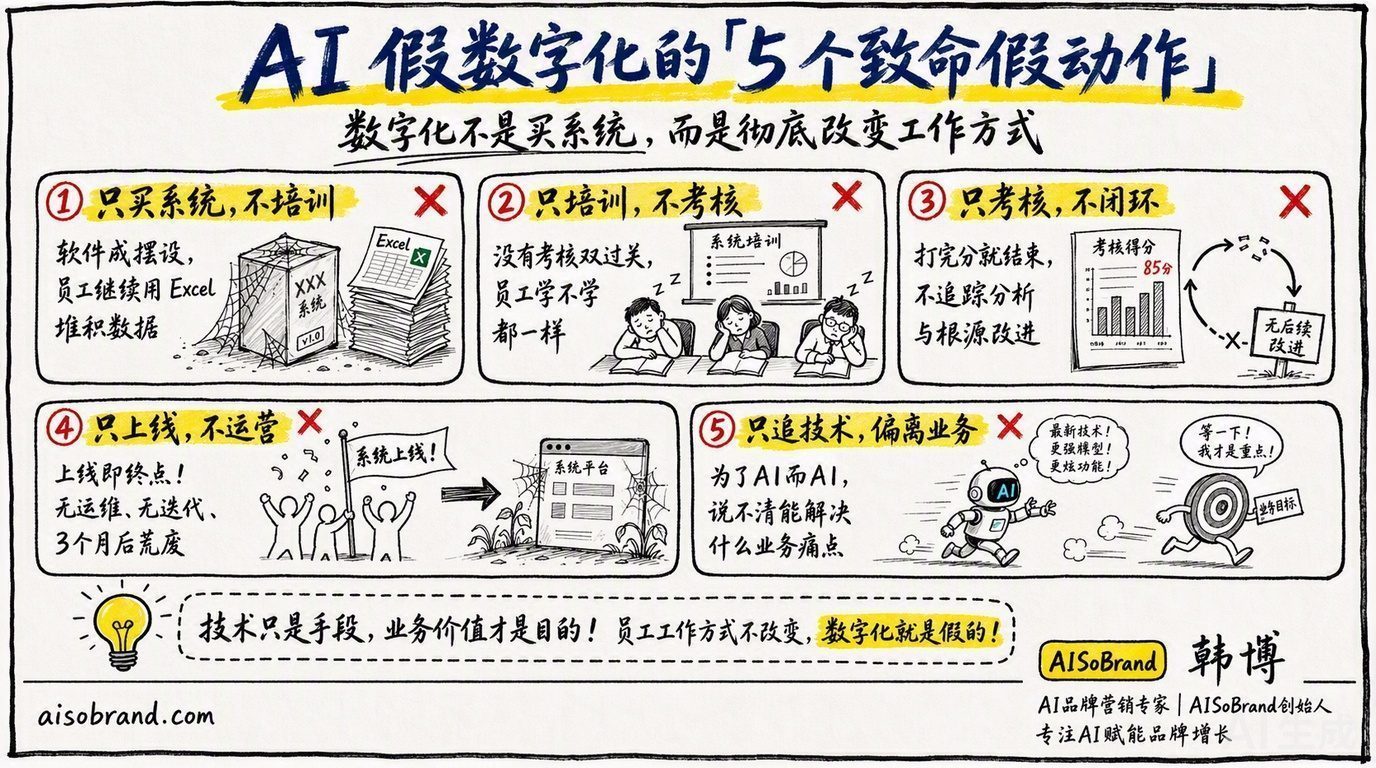
Four typical signs of "fake effort" and their root causes
2. Five Signs of AI Fake Digitalization
Based on my 22 years of hands-on brand digitalization experience, there are 5 typical signs of AI fake digitalization. Check yourself — how many does your company have?
Looking busy vs. actually effective transformation
Fake Move 1: Buying Systems Without Training
Symptom: Spent hundreds of thousands on ERP/CRM, and then... nothing. Employees don't know how to use it, no one teaches them, and the system becomes decoration.
Why it's a fake move: Systems are just tools; people are the core. Without training, employees won't use it; if they don't use it, the system is scrap metal.
Correct approach: Train before the system goes live. Not a formality "group lecture," but "hands-on teaching + pass-or-fail assessment." Every role, every operation, must be trained thoroughly.
📊 Real Case
A chain retail brand spent 500,000 on a new ERP. On day one, warehouse staff couldn't operate it, causing shipping delays and a surge in customer complaints. They then spent 3 months on training, and once staff became proficient, shipping efficiency increased by 40%.
Fake Move 2: Training Without Assessment
Symptom: Training was done, employees attended, but... what were the results? Nobody knows. Because there's no assessment, whether employees learned or can use it is entirely self-directed.
Why it's a fake move: Training without assessment equals no training. Employees think: "It doesn't matter whether I learn or not, the boss won't know."
Correct approach: Must assess after training. Theory exam + practical assessment, passing both counts as completion. Assessment scores should be tied to performance reviews and bonuses.
💡 Han Bo's Tip
Training assessments can't be one-time; they need regular re-testing. Because employees forget, and systems upgrade. We recommend quarterly assessments to maintain proficiency.
Fake Move 3: Assessment Without Closed-Loop Improvement
Symptom: Assessments were done, problems were found, but... then what? Nothing. Problems remain problems, errors remain errors, and the next assessment shows the same mistakes.
Why it's a fake move: The purpose of assessment is improvement, not scoring. If there are no improvement measures after assessment, the assessment is a waste of time.
Correct approach: Build a "assess - analyze - improve - re-assess" closed loop. After each assessment, analyze root causes, develop improvement measures, and track improvement results.
Fake Move 4: Going Live Without Operations
Symptom: The system went live, the boss was happy, sent a company-wide email: "We've gone digital!" Then... nothing. No one maintains the system, no one analyzes data, no one optimizes features.
Why it's a fake move: Going live is just the beginning; operations are the key. Not going live means waiting to die; going live without operations means seeking death.
Correct approach: After the system goes live, someone must be responsible for operations. This includes: data monitoring, issue resolution, feature optimization, and user feedback collection. We recommend establishing a "system operations specialist" role.
⚠️ Warning
Many companies' digitalization projects die at the "go-live is the endpoint" trap. After the system goes live, the boss thinks everything is fine, and 3 months later, the system is abandoned. Remember: going live is just the beginning; operations are the long-term work.
Fake Move 5: Chasing Technology Without Pursuing Business Value
Symptom: Chasing trendy technologies — AI, big data, blockchain... whatever is hot, they pursue it, but without understanding what business problems these technologies can solve.
Why it's a fake move: Technology is a means; business value is the goal. Pursuing technology for technology's sake is fake digitalization.
Correct approach: Start from business pain points, then choose technology. First ask "what problem do I need to solve," then ask "what technology to use." Don't do it backwards.
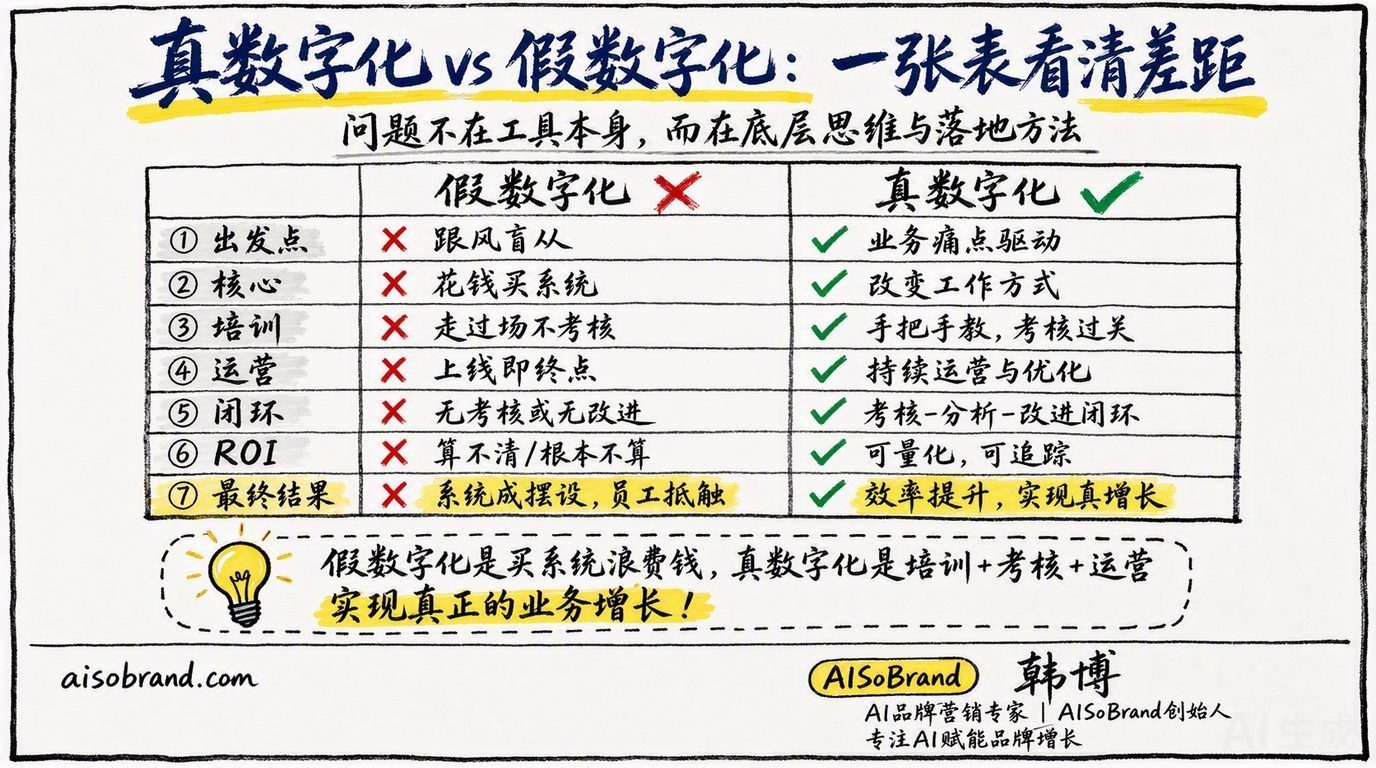
3. Real Digitalization vs. Fake Digitalization: One Table Shows the Gap
| Dimension | Fake Digitalization | Real Digitalization |
|---|---|---|
| Starting Point | Following trends — others did it, so should I | Starting from business pain points |
| Core | Buying systems | Changing how work is done |
| Training | Going through the motions, no assessment | Hands-on teaching, pass-or-fail assessment |
| Operations | Go-live is the endpoint | Continuous operations, continuous optimization |
| Assessment | No assessment, or no closed loop | Assess - analyze - improve - re-assess |
| ROI | Can't calculate clearly, or never calculated | ROI is quantifiable and trackable |
| Result | System becomes decoration, employees resist | Efficiency improves, employees embrace it |
The problem isn't the tool, it's the mindset and methodology
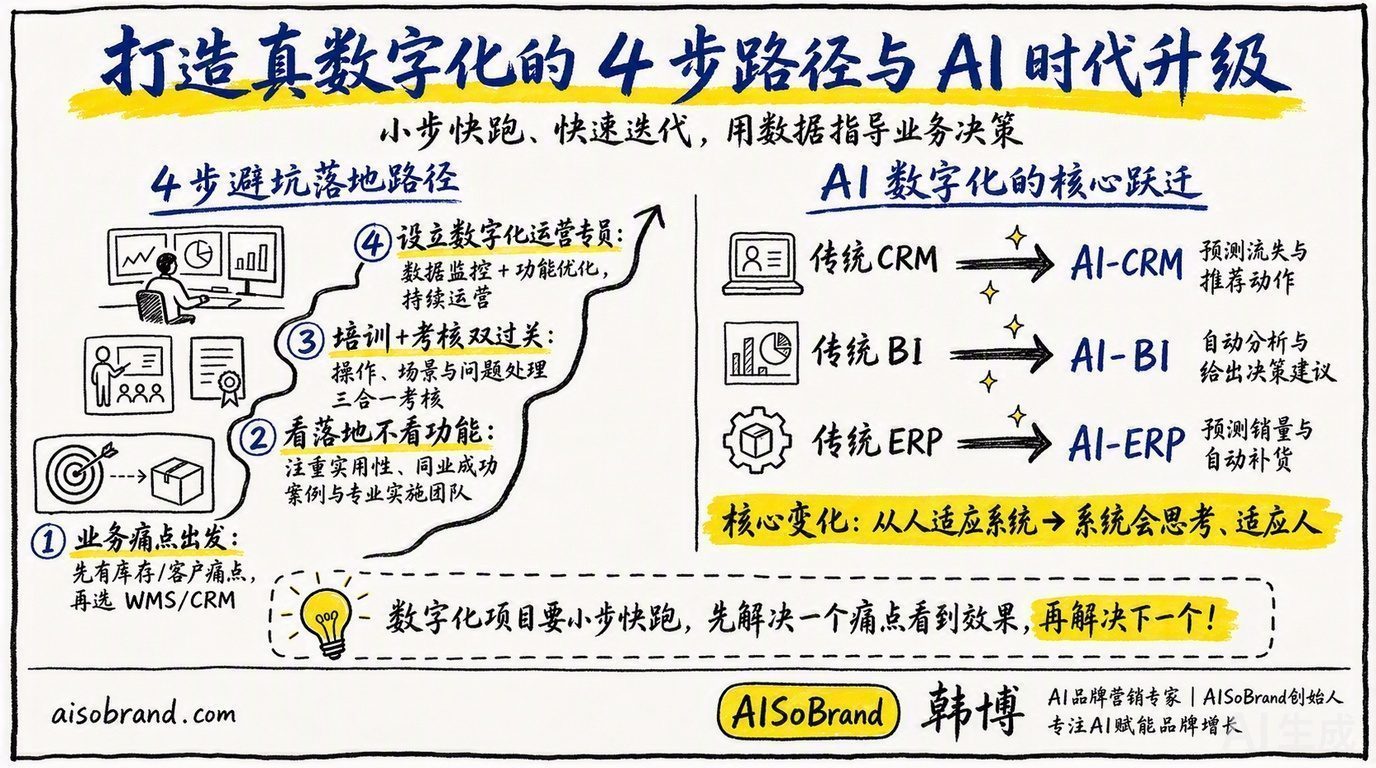
4. How to Avoid Fake Digitalization? 4 Steps to Build Real Digitalization
The three-step path to genuine digital transformation
Step 1: Start from Business Pain Points, Not Technology Selection
Don't ask "what system should I deploy," ask "what business problem do I need to solve." For example:
- Inaccurate inventory → Deploy WMS (Warehouse Management System)
- Customer churn → Deploy CRM (Customer Relationship Management)
- Store management difficulty → Deploy chain management system
Identify the problem first, then choose the system. Don't do it backwards.
Step 2: When Choosing Systems, Look at Implementation, Not Feature Lists
Many bosses choose systems by looking at feature lists: "Wow, this feature is great, that one is too." Result: they buy it, and 90% of features go unused.
Correct approach: When choosing a system, look at 3 things:
- Does it fit your business scenarios (don't pursue comprehensive, pursue practical)
- Are there success cases (have companies in the same industry and scale used it?)
- Is the implementation team professional (the system is one thing, implementation is another)
Step 3: Training + Assessment, Both Must Pass
Before the system goes live, training is mandatory. After training, assessment is mandatory. If assessment isn't passed, the employee can't take their post.
Training content should include:
- System operation (how to use it)
- Business scenarios (when to use it)
- Issue handling (what to do when problems arise)
Step 4: Continuous Operations, Data-Driven
After the system goes live, someone must operate it. Operations include:
- Data monitoring (system usage, business metric changes)
- Issue handling (employee-reported issues must be resolved promptly)
- Feature optimization (adjust system features based on business changes)
- Data analysis (use system data to guide business decisions)
💡 Han Bo's Recommendation
For digitalization projects, we recommend establishing a "digitalization operations specialist" role. This person should understand both business and systems, responsible for daily operations and continuous optimization. Without this role, digitalization projects are unlikely to succeed.
5. In the AI Era, How Should Digitalization Be Done?
Traditional digitalization is "moving offline to online"; AI digitalization is "making systems think."
For example:
- Traditional CRM: Records customer information → AI-CRM: Predicts customer churn, recommends marketing actions
- Traditional BI: Displays data reports → AI-BI: Automatically analyzes problems, provides decision recommendations
- Traditional ERP: Manages inventory and orders → AI-ERP: Predicts sales, auto-replenishes stock
The core of AI digitalization: It's not about making people adapt to systems, but making systems adapt to people. Systems learn, think, and recommend; people just need to make decisions.
6. Conclusion: Digitalization Is the Means, Business Growth Is the Goal
Do less ineffective things, do more effective things, focus on long-term value
Having written all this, here's what I want to tell you:
Digitalization is not the goal; business growth is the goal.
Don't digitalize for digitalization's sake, don't do AI for AI's sake. First think clearly about the business problem, then choose the technology solution.
Remember:
- Fake digitalization: Buy systems, no training, no assessment, no operations → Wasted money
- Real digitalization: Start from business, training + assessment + operations, quantifiable ROI → Real growth
Do you want real growth or fake digitalization? The choice is yours.
What's Your Brand's Status in AI Search?
Chengying Ruanbo offers a free brand AI search presence check, covering mainstream platforms including Doubao, Qianwen, Wenxin, and DeepSeek. Report delivered in 3 minutes.
Free Check Now →