Your Corporate Website's AI Readability: How Schema Structured Data Becomes the Technical Foundation of GEO
For the past decade, enterprises pursued "visual impact" for their websites — flashy banners, smooth animations, refined layouts. But now that generative AI has become the mainstream information gateway, this aesthetic standard is failing. AI crawlers don't care how pretty your page is; they care about one thing: whether your information is structured and can be accurately extracted and cited. This is the true technical starting point of enterprise GEO (Generative Engine Optimization) — AI readability.
I. Why Traditional Websites Are "Invisible" in AI Search
We've audited many corporate websites and found a common pattern: they aren't short on content, yet when AI like Doubao, DeepSeek, and ChatGPT answer industry questions, these companies are almost never cited. The root cause is usually not "poor content quality" but "the machine can't read it."
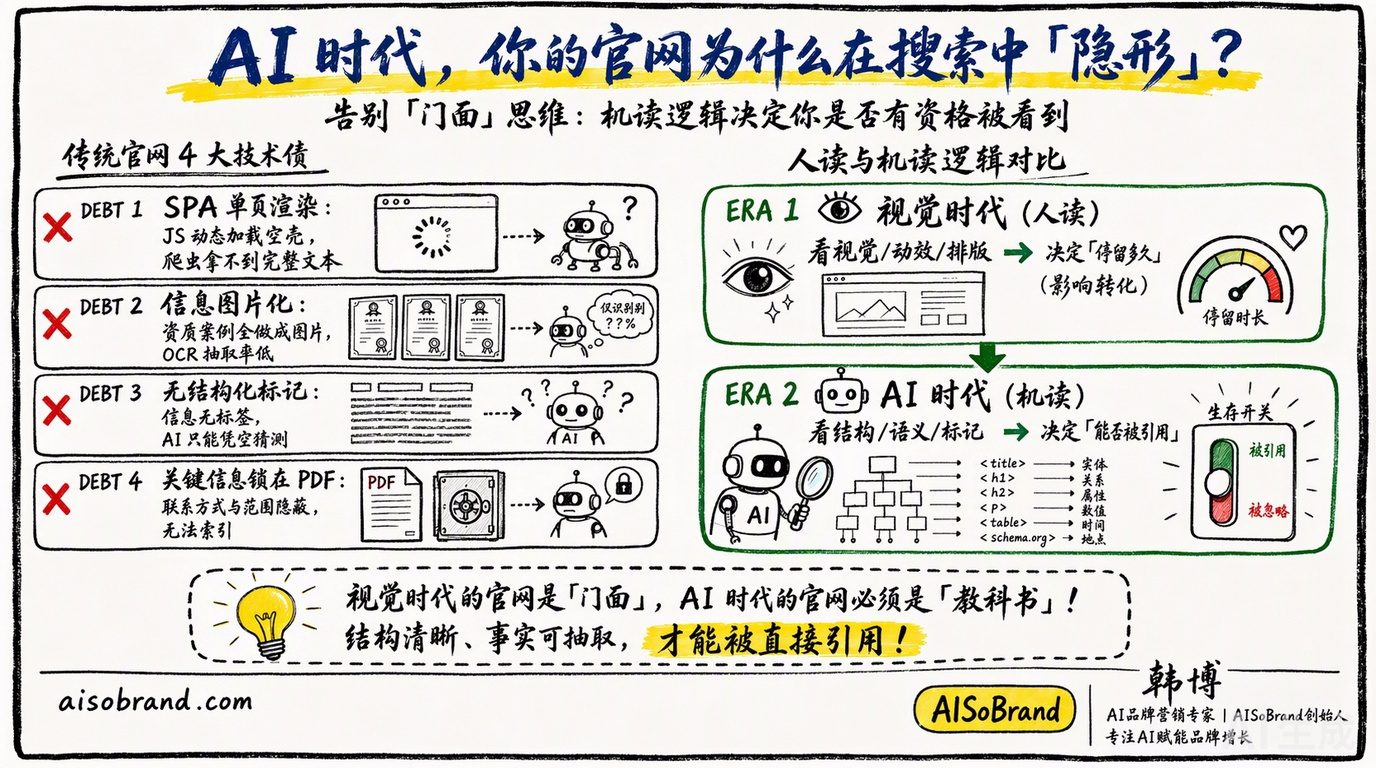
Human reading and machine reading follow two different logics. Humans infer meaning from visuals and context; AI extracts entities, relations, and facts from HTML structure and semantic markup. When a website carries the following types of "technical debt," AI essentially skips it:
1. SPA (Single-Page App) rendering: Content is generated dynamically by JavaScript, the server returns an empty shell, and AI crawlers can't get the full text.
2. Information as images: Company intro, credentials, and cases are all images; OCR extraction rates are low and entities can't be linked.
3. No structured markup: AI can't tell "which part is the product, which is the credential, who's responsible" and can only guess.
4. Key info locked in PDF/JS: Contact details and service scope are scattered in downloadable files that neither search engines nor AI can easily index.
In one line: in the visual era a website was a "storefront," but in the AI era it must be a "textbook" — clear structure, extractable facts, directly citable.
II. The Technical Foundation of AI Readability: Structured Data (Schema Markup)
The most mature, lowest-cost engineering approach to make AI "get you instantly" is structured data (Schema.org vocabulary + JSON-LD format). It's essentially a machine-readable "metadata" block embedded in the page that explicitly tells AI: this is a company, what services it offers, which regions it covers, and what credentials it holds.
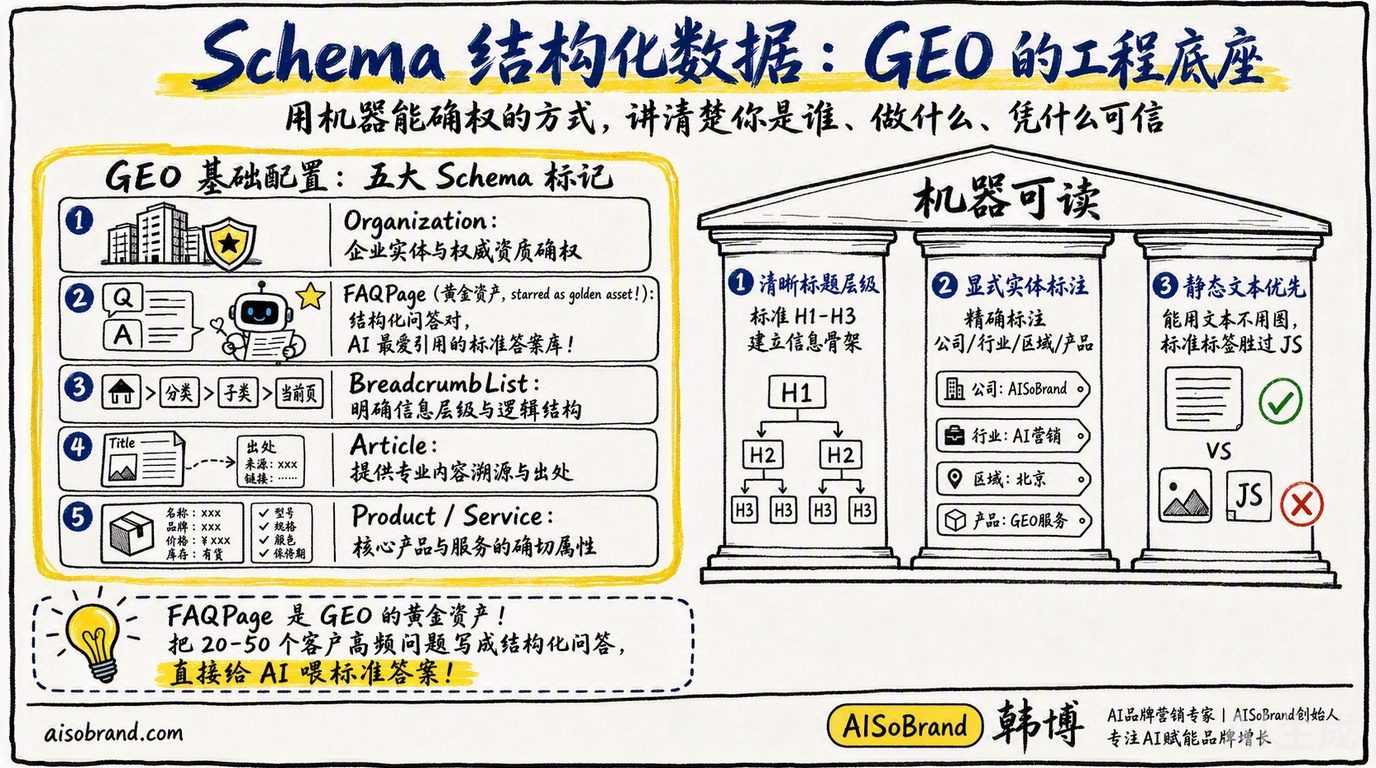
For a corporate website, the following five Schema types are the "basic configuration" of GEO:
corporate entity & credentials
Q&A pairs · AI's favorite to cite
information hierarchy
content provenance
Among these, the FAQPage Schema is the "golden asset" of GEO. When answering industry questions, AI prefers citing "structured Q&A pairs" over prose. Writing your customers' 20–50 most common questions as Schema-tagged Q&A is like proactively feeding AI a "standard answer library" — your citation probability rises significantly.
III. From "Human-Read" to "Machine-Read": Semantic HTML and Entity Annotation
Beyond structured data, the semantic skeleton of the page itself is equally critical. AI relies heavily on the "hints" from HTML tags when extracting information:
Clear heading hierarchy: One H1 per page, sections in H2/H3 — AI builds the "information skeleton" from this.
Entity annotation: Explicitly state "company name / industry / service region / core products" so AI forms an entity understanding of "who you are" instead of guessing from marketing copy.
Machine-readable over visually-friendly: Use text not images, standard tags not custom divs, static rendering not JS.
"AI readability" isn't a makeshift for machines; it's articulating a company's most essential facts — who you are, what you do, and why you're trustworthy — in a way machines can assert with certainty.
IV. Enterprise Implementation Checklist (Technical Side)
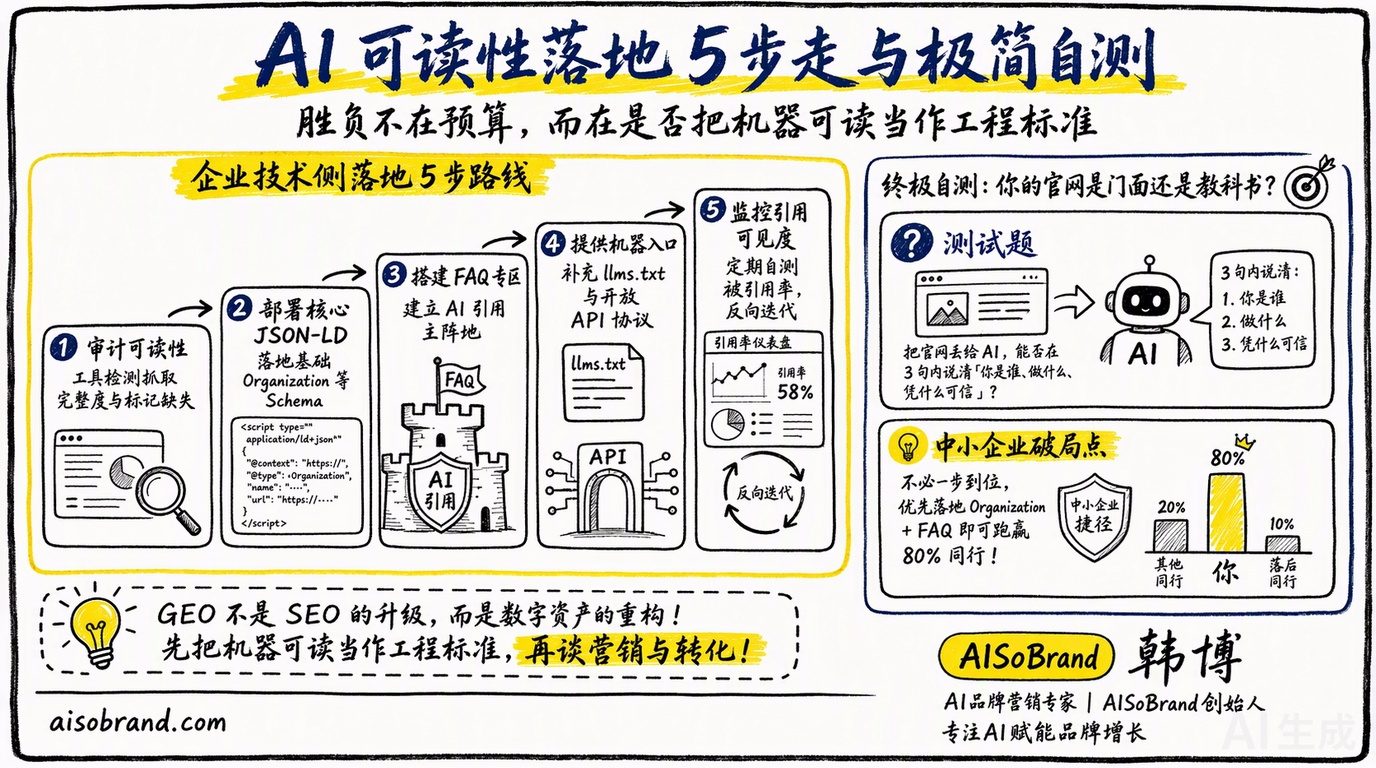
Turning a website "AI-readable" doesn't require starting over. Chengying Ruanbo's standard for enterprise tech teams is five steps:
- Audit the machine-readability of existing pagesUse tools like Rich Results and Schema Validator to check whether key content is fully crawled and whether structured markup is missing.
- Deploy core JSON-LDImplement the three base Schema types (Organization, WebSite, BreadcrumbList) on the homepage and core pages.
- Build a structured FAQ zoneWrite customers' high-frequency questions as an FAQPage Schema Q&A library, your primary ground for AI citation.
- Provide machine-readable entry pointsGradually add llms.txt and open APIs so a stable "reading protocol" exists between AI and your systems.
- Monitor AI citation and visibilityPeriodically self-test with industry keywords on mainstream AI platforms, quantify the "citation rate," and iteratively refine Schema and content.
V. A Litmus Test: Is Your Website a "Storefront" or a "Textbook"?
Here's a minimal self-test for companies: imagine a procurement officer who knows nothing about you, and you only hand AI your website. Can AI state "who you are, what you do, and why you're trustworthy" in three sentences? If not, your website is still a "storefront" — invisible in AI's eyes.
For resource-limited SMEs, you don't need everything at once: just deploy the Organization and FAQ Schema types and you're already ahead of most peers. The outcome of enterprise GEO often comes down not to budget, but to the cognitive gap of "whether you treat machine-readability as an engineering standard."
Check your brand's visibility in AI search — for free
Can AI actually read your website? One free GEO diagnosis shows you exactly how your brand is cited across mainstream AI platforms.
Get Free Diagnosis →