Got a Free GEO Diagnostic, Then What? 3 Steps to Turn AI Diagnostic Reports into Client Leads
You did a free GEO diagnostic, and AI gave you a report with 30 questions. Then what? Most companies stop here — they skim the data, think "looks professional," and then... nothing.
This is a massive waste. Your diagnostic report is actually a precise customer acquisition map. The problem is, you do not know how to read it, how to use it, or how to turn it into real business opportunities.
This article breaks down a 3-step method to help you turn a diagnostic report into reachable, trackable, and convertible client leads.
Step 1: Read Your Diagnostic Report and Find the Most Compelling Data
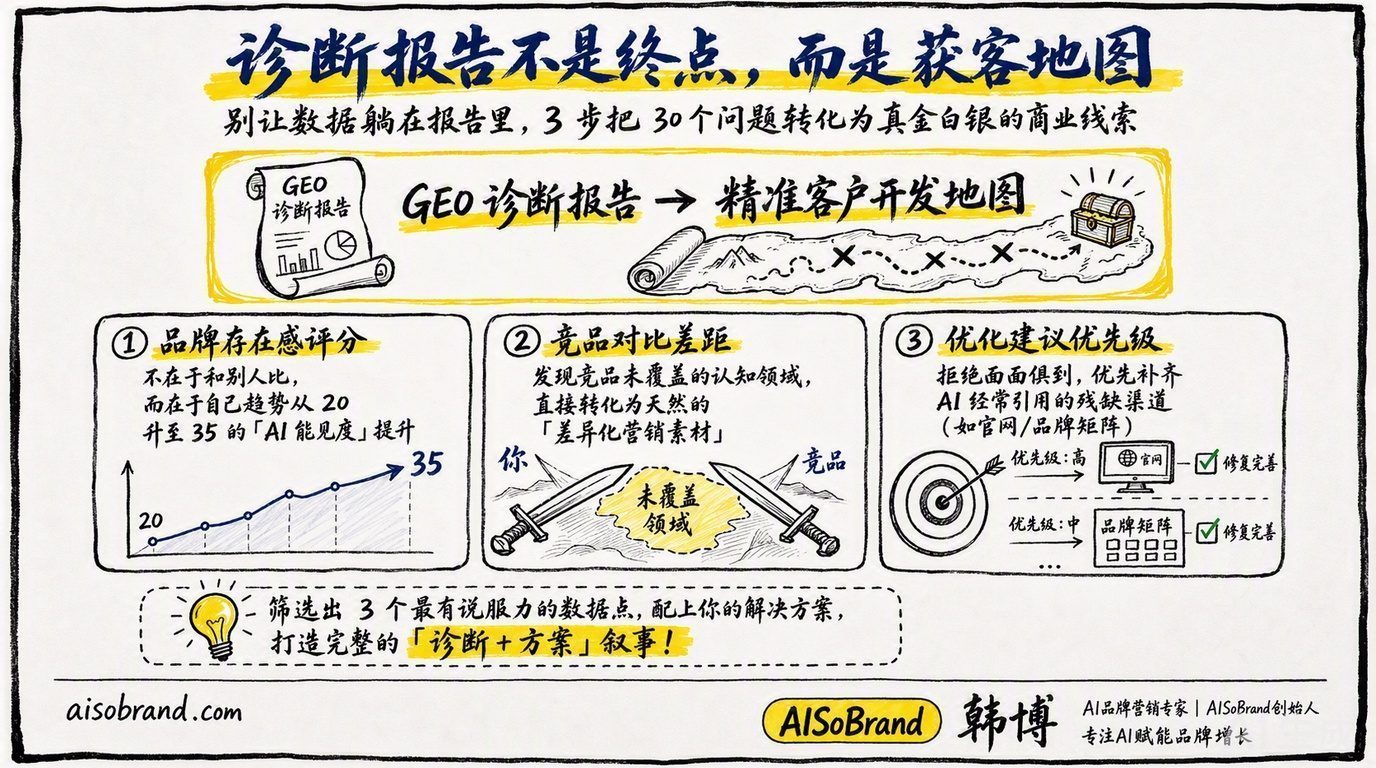
When you get the diagnostic report, your first reaction is usually "Wow, thats a lot of data." But the data with real business value is often just a few core metrics. Knowing which data points most resonate with your decision-makers is the key.
(1) Brand Presence Score: Compare Yourself to Yourself
This score is not "where you rank in the industry," but "how often AI mentions you when answering related questions." A score of 50 means AI mentions you half the time; 20 means you are virtually "invisible."
What truly matters is the trend of this score. After you do content optimization, the score goes from 20 to 35 — this is not just a number change; it is your brand "visibility" improving in the AI world.
(2) Competitor Comparison: The Gap Is the Best Differentiation Material
The diagnostic report typically lists the coverage of 3-5 competitors. This comparison data is natural differentiation positioning material.
If you find that competitor A is frequently mentioned in "technical solution" questions but nearly invisible in "price comparison" questions, that is your opportunity. Your content can cut in with "transparent pricing, clear solutions" to occupy a cognitive area competitors have not yet covered.
This kind of data is highly persuasive whether made into WeChat Moments content or sent to potential clients — because it is objective data from a third party (the AI platform), not something you claimed yourself.
(3) Optimization Priority: Which Should You Do First?
GEO diagnostics typically give you a pile of suggestions: complete brand story, update product descriptions, add customer cases, improve website information density... Too many suggestions equals no suggestions.
Here is a judgment criterion: Prioritize the scenarios where AI most frequently "cites" your existing content sources. If AI frequently cites your website but the website information is incomplete — then the website is the highest-priority project. If AI almost never cites any of your sources — then start with a brand content matrix.
Diagnostic report usage principle: Do not send all the data to clients. Instead, select the 3 most compelling data points, pair them with the solutions you can provide, and form a complete "diagnosis + solution" narrative.
Step 2: Turn Diagnostic Data into Social Currency, Proactively Create Touchpoint Opportunities
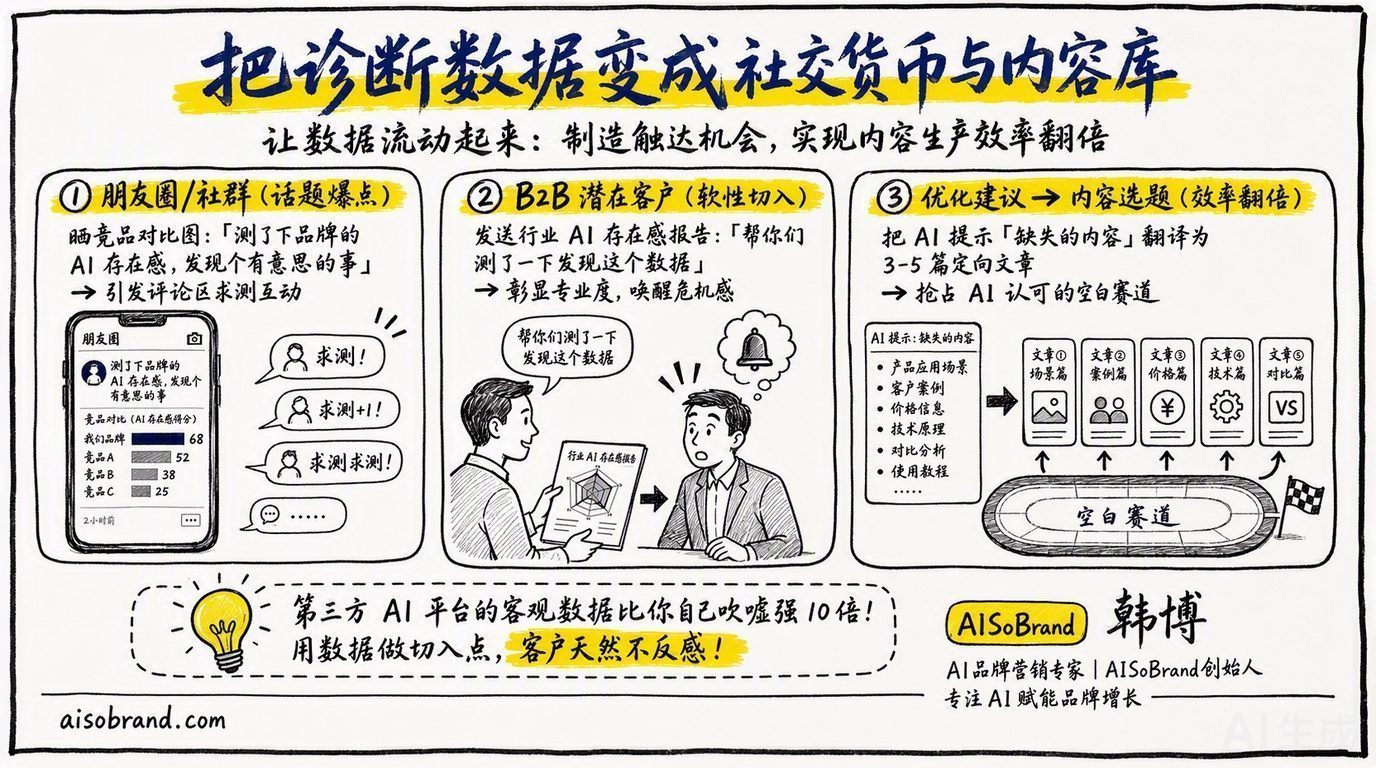
Data sitting in a report is dead data; making it flow is what turns it into an asset. Competitor comparisons, brand scores, and optimization gaps in the diagnostic report are all natural social content material.
Scenario 1: WeChat Moments / Communities — "What Does Your Brand Look Like in AIs Eyes?"
You can turn the competitor comparison data from the diagnostic report into an image and post it to WeChat Moments or industry communities. The title could be: "Tested our brand AI presence and found something interesting..."
This type of content is inherently conversational — it reveals a perspective many people do not know about. The comments section often has interactions like "How did you test that?" and "We should test ours too," proactively creating touchpoint opportunities.
Scenario 2: Send to Potential Clients — "Here Is the AI Presence Report for Your Industry"
If you are in B2B sales and have a diagnostic report for the client industry (even a general version), send it to potential clients saying: "Ran a test for you and found this data..."
This action has several values:
- Demonstrates your professionalism (you know industry trends)
- Creates a conversation starter (starting from data, not hard-selling products)
- Makes the client aware of the problem (they may have never considered that their brand is invisible in AI)
Scenario 3: Turn Optimization Suggestions into Topics — Double Your Content Production Efficiency
The optimization suggestions from GEO diagnostics are essentially the content AI thinks "you are missing." Translate each optimization suggestion into a topic, and you have an inexhaustible content material library.
For example, if the diagnostic suggests "add more founder industry insight content," you write 3-5 articles around this, each one targeting a content track AI considers valuable and competitors have not yet occupied.
Key Insight: A GEO diagnostic report is not a "finished" document, but a "starting" map. Reading it well and using it actively is the true starting point for customer acquisition.
Step 3: Design a Conversion Funnel, Make Lead Capture a Natural Outcome
After the first two steps, the user is already interested. Step 3 is to convert this interest into a specific lead-capture action — getting them to leave contact information in exchange for a more complete report or personalized plan.
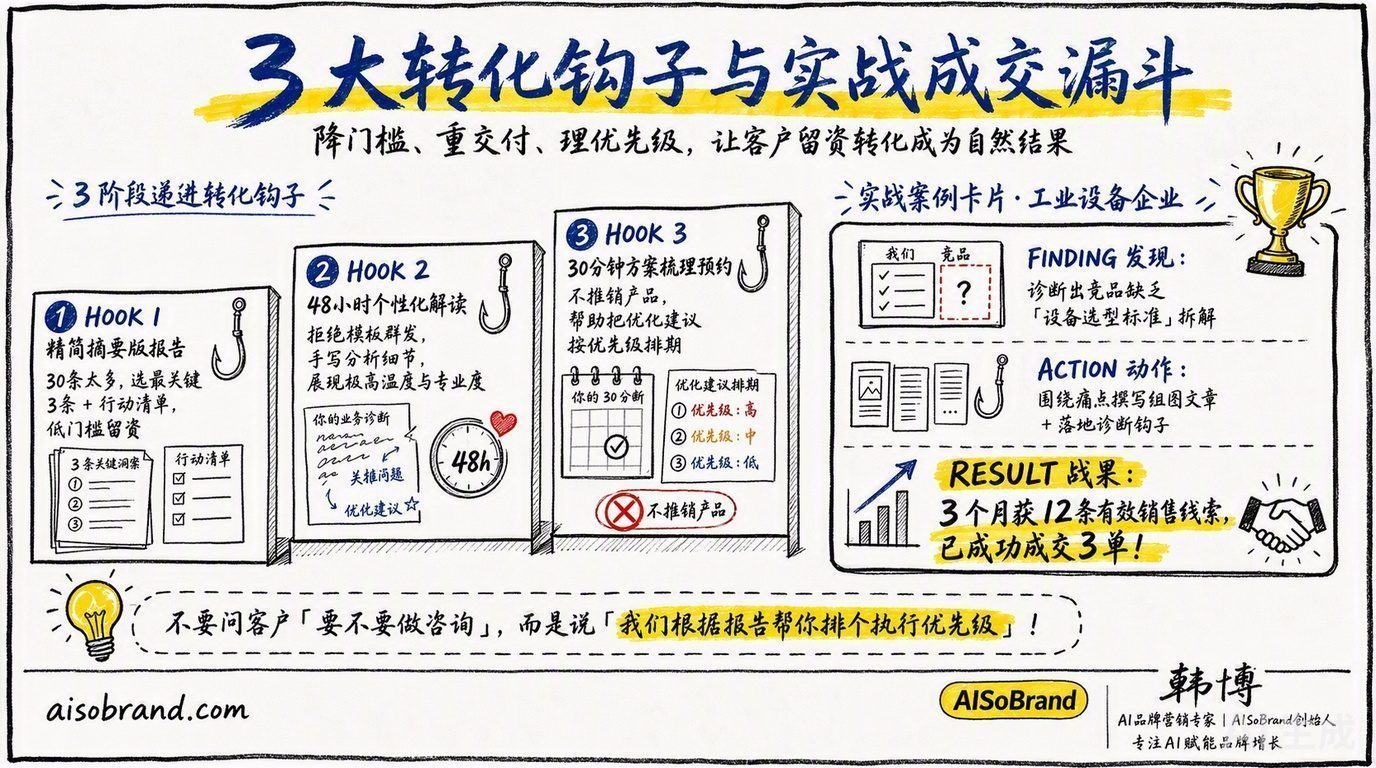
Conversion Hook 1: Full Report — "30 Questions Is Too Many, Here Are the Top 3"
Diagnostic reports are typically long — 30 optimization suggestions is too much information for SME owners. Here is a conversion technique: offer a "summary version" report as a lead-capture incentive.
The full version has 30 suggestions; the summary version selects the top 3, paired with a simple action checklist. The lead-capture threshold is low (just a phone number or email), but the delivery feels substantial (a report they can use immediately).
Conversion Hook 2: Personalized Interpretation — "Your Report, Our Analysis"
Within 48 hours of lead capture, proactively send a personalized message: "Reviewed your diagnostic report and found a few points particularly worth noting..." Not a template — a genuine analysis based on their data.
This action conversion rate is far higher than automated emails because it demonstrates genuine professionalism and attentiveness. The user feels "you actually looked at my situation," not "you are mass-sending template messages."
Conversion Hook 3: Book a Consultation — "Based on Your Report, We Will Customize a Plan for You"
After the first two steps, the user already has a sense of your diagnostic capability and professionalism. Converting to a consultation at this point has the least resistance.
Key script: Not "Would you like a consultation?" but "Based on your report, we recommend a 30-minute plan review session, where we will prioritize all optimization suggestions for you, so you can execute them directly afterward."
Case Study: An industrial equipment company used a free GEO diagnostic to discover that "competitors are frequently mentioned in 'equipment selection' type queries, but none of them has broken down selection criteria in detail." They wrote a series of articles around this, and within 3 months, generated 12 qualified sales leads through article-based lead capture, of which 3 closed deals.
FAQ
What's Your Brand's Status in AI Search?
Chengying Ruanbo offers a free brand AI search presence check, covering mainstream platforms including Doubao, Qianwen, Wenxin, and DeepSeek. Report delivered in 3 minutes.
Free Check Now →