GEO in Practice: How to Build Brand Digital Presence in the AI Era
In 2026, the standard for measuring brand digital presence has changed. It is no longer about where you rank on Baidu, but whether your brand appears in the answer when a user asks AI to "recommend a few companies in your industry."
I recently helped over a dozen companies with AI search presence diagnostics and discovered a sobering truth: many companies have spent heavily on websites, content, and promotion, but in AIs eyes, they are virtually invisible.
This article skips theory and focuses on practice — how to make your brand go from "non-existent" to "recommended by AI" in the AI era.
01 First, Understand: GEO Is Not an Upgrade of SEO
Many business owners ask me: Is GEO just SEO for the AI era?
My answer: It is not an upgrade; it is a completely different game.
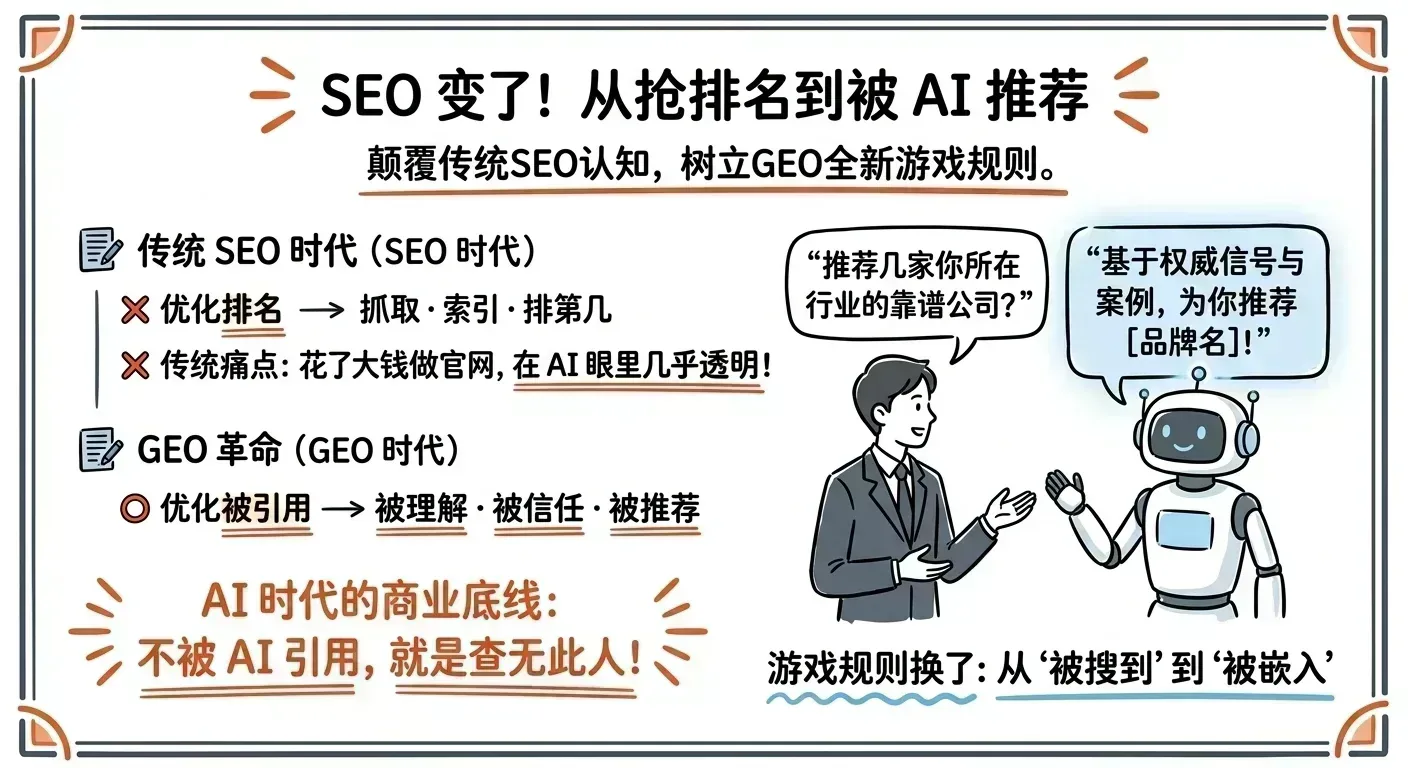
SEO optimizes rankings — getting search engines to rank your pages higher.
GEO optimizes "being cited" — getting AI to mention your brand, quote your content, and recommend your services when answering questions.
The logic behind this is fundamentally different:
- SEO era: User searches keywords → Search engine returns a list of links → User clicks to visit
- GEO era: User asks a question → AI synthesizes an answer directly → Brand is "embedded" in the answer
In the SEO era, your goal was "to be crawled, indexed, and ranked." In the GEO era, your goal is "to be understood, trusted, and recommended".
So companies still using SEO thinking for GEO are destined to take the long way around.
02 Three Diagnostic Metrics: How Much Is Your Brand Worth in AIs Eyes?
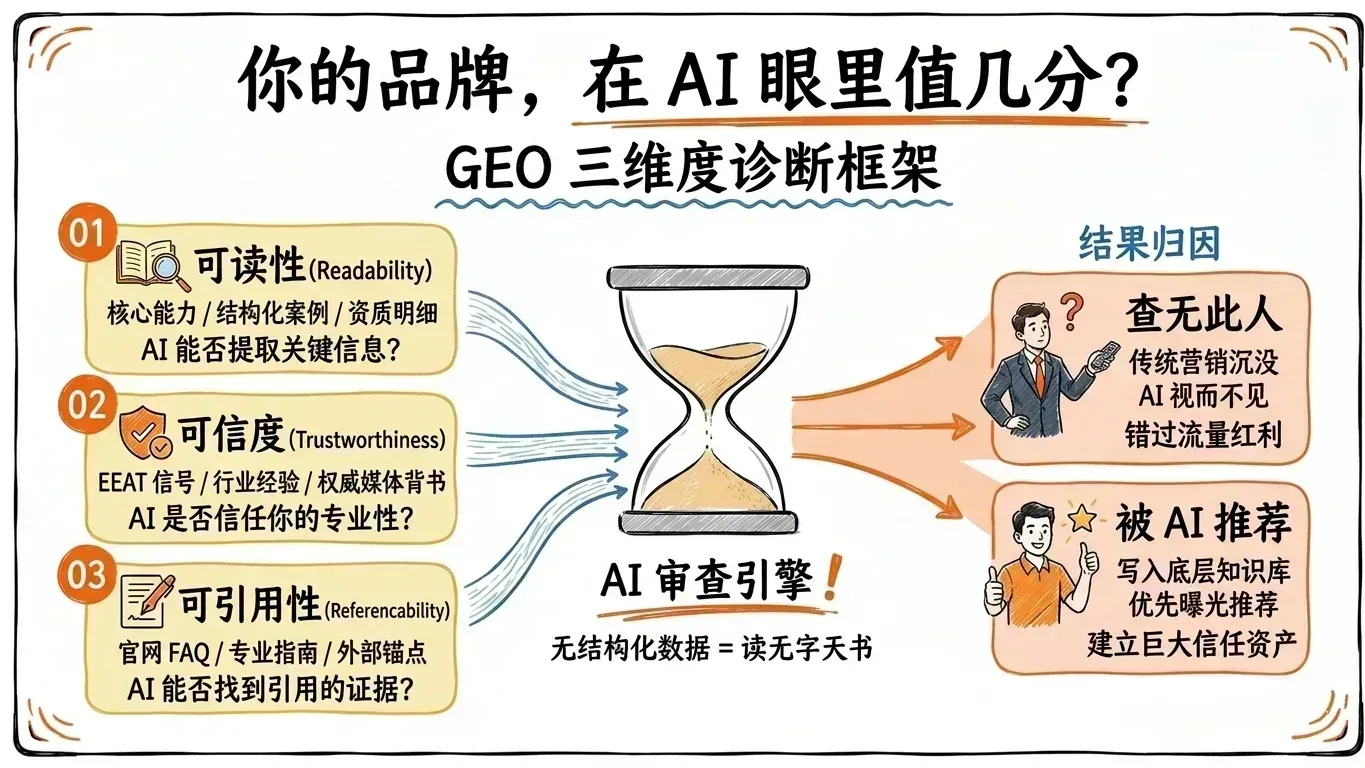
Before starting GEO, do a diagnostic first. I have summarized a three-dimensional diagnostic framework:
Dimension 1: Readability (Can AI understand you?)
Open your website and ask yourself three questions:
- Can AI extract your company core capabilities? (e.g., "specializes in Central Asian logistics, holds border customs clearance qualifications")
- Do your service cases have a clear structure? (Background-Solution-Result, or just a vague paragraph?)
- Can AI find your certifications and industry endorsements? (Or are they hidden in PDF attachments?)
If the answers to these three are "unclear, no structure, cant find it," then AI reading your website is like reading a blank book.
Dimension 2: Trustworthiness (Is AI willing to trust you?)
When AI judges whether a company is worth recommending, it looks at E-E-A-T signals:
- Experience: Is there a real record of industry experience?
- Expertise: Is there professional content output? Industry analysis, operational guides, trend interpretations?
- Authoritativeness: Has the company been featured by authoritative media, industry associations, or exhibitions?
- Trustworthiness: Are there customer reviews, certifications, and third-party endorsements?
For most mid-sized B2B companies, all four are weak. When AI searches for "reliable suppliers" and finds no authoritative signals about you, it naturally will not recommend you.
Dimension 3: Citability (Does AI have material to cite you?)
When AI answers questions, it needs "source material to cite." Does your brand have enough structured, AI-citable content?
- Website FAQ: Standard answers to common customer questions
- Industry articles: Professional insights, case analyses, operational guides
- External content: Media coverage, industry portal articles, third-party reviews
If none of these exist, even if AI wanted to recommend you, it could not find "evidence."
03 Three-Step Transformation: Make AI Know You, Trust You, and Recommend You
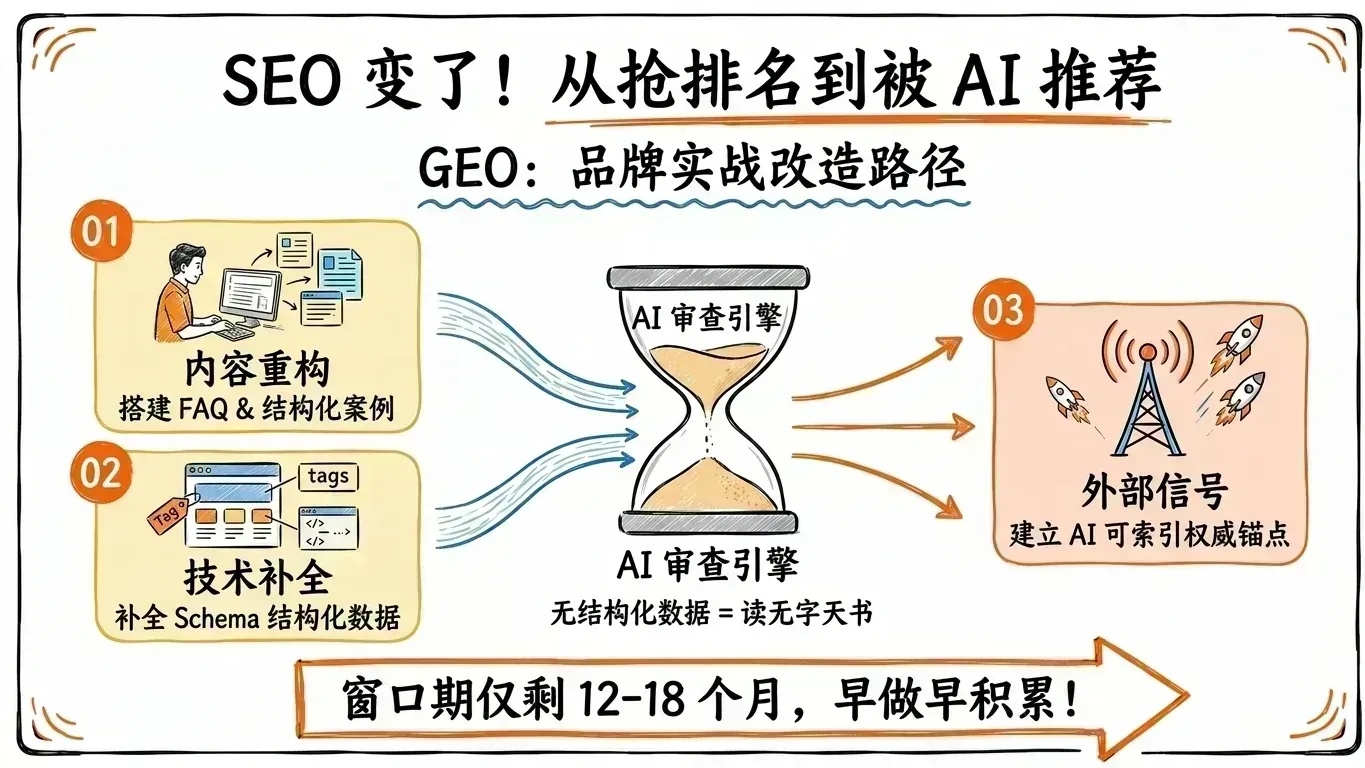
After the diagnostic, the transformation starts from three levels:
Step 1: Content Level — Make Business Capabilities "Extractable"
It is not about rewriting the website, but adding "AI-friendly content."
Specific actions:
- Structured description of core capabilities: For each business line, use 200-300 words to clearly state: which clients you serve, what problems you solve, what advantages you have, and what cases you have. Do not use empty words like "professional, efficient, caring" — speak with data and facts.
- Build a FAQ section: Write 30-50 common customer questions in Q&A format. AI loves citing this format — clear questions, definitive answers, standard structure.
- Structure case studies: Write each case in a four-part format: "Background-Challenge-Solution-Result," so AI can extract a complete story.
Step 2: Technical Level — Add Schema Structured Data
Add JSON-LD markup such as Organization, LocalBusiness, and FAQPage to the website header. Feed company address, certifications, and service scope to search engines in standard formats AI can read.
The technical cost is low, but the AI-friendliness improvement is significant.
Step 3: External Signals — Build AI-Indexable Authoritative Content
Publish professional articles in industry media, participate in industry association activities and get coverage, and establish brand content anchors on third-party platforms.
Let AI find your "professional voice" when retrieving related information.
04 A Real Case: From "Non-Existent" to "Recommended by AI"
When I ran a diagnostic for a Xinjiang-based international logistics company, I found that it had been operating in Central Asian logistics for nearly 20 years, had its own office building in Urumqi, and operated multiple mature routes to Central Asia and Europe. But when I asked Doubao "which reliable companies do Central Asian logistics," the answers were all giants like COSCO, China Shipping, and Maersk — its name never appeared.
After three months of transformation, I tested with the same questions:
- "Which companies in Urumqi do Central Asian logistics" → This company appeared in the recommendation list
- "Which company is reliable for Khorgos port customs clearance" → AI started citing content from its website
- "Kashgar-Kalasu route quotes" → AI provided its website contact information as a reference
It was not overnight fame, but going from "non-existent" to "AI can describe what this company does and what advantages it has." For B2B companies, this is already a significant accumulation of trust assets.
05 The GEO Window: More Urgent Than You Think
The traffic dividend window for AI search is approximately 12-18 months.
Content assets and AI citation records established by early movers will create an increasingly strong Matthew effect. Latecomers will face exponentially higher costs to catch up.
Companies still pouring their entire budget into traditional advertising are missing a window that could reshape their customer acquisition landscape for the next three years.
What's Your Brand's Status in AI Search?
Chengying Ruanbo offers a free brand AI search presence check, covering mainstream platforms including Doubao, Qianwen, Wenxin, and DeepSeek. Report delivered in 3 minutes.
Free Check Now →