Enterprise GEO in Practice: Using a Knowledge Graph to Make AI Truly "Understand" Your Business
In the previous article we covered "AI readability" — making AI understand your website. But being readable doesn't equal being understood or recommended. In many enterprise GEO audits, Chengying Ruanbo found sites with complete Schema and clear semantics: AI can accurately extract "this is a company and what it does," yet when a user asks "recommend a few reliable XX suppliers," AI still doesn't mention it. The bottleneck is the "understanding" layer. To make AI take your side when answering customer questions, you need to go further: organize scattered facts into a machine-reasoning knowledge graph. This is the engineering leap that takes enterprise GEO from "indexable" to "recommendable."
I. Why "Readable" Isn't Enough: The Trust Threshold for AI Recommendation
Readability lets AI "pick up" your information; understandability makes AI "trust and cite" it. Between the two lies a trust threshold. We've compared citation-rate data across dozens of industries: companies with complete website info that still aren't recommended by AI almost always hit the same wall — their information is a scattered mess, and AI can't build the relationship network of "who serves whom, why you're credible, and how you differ from peers" during reasoning. So in decision scenarios that require comparison, ranking, and recommendation, AI leans toward citing competitors with higher information density and clearer relationships.
1. Entity isolation: Company, products, cases, and credentials each stand alone; AI can't aggregate "who you really are," and repeated phrasing further dilutes entity weight.
2. Missing evidence chain: Key claims lack verifiable sources — license numbers, customer endorsements, third-party citations — so AI won't stake "credible" on you.
3. No differentiated positioning: AI can't tell you apart from peers, thinks "anyone will do," and falls back to ranking by fame.
4. Insufficient citation motive: Without structured argument material for "why choose you," AI has nothing to say when justifying a recommendation.
Readability is the entry ticket; understandability is the right to be recommended. The deeper goal of enterprise GEO isn't to be "seen," but to make AI "take your side" during reasoning.
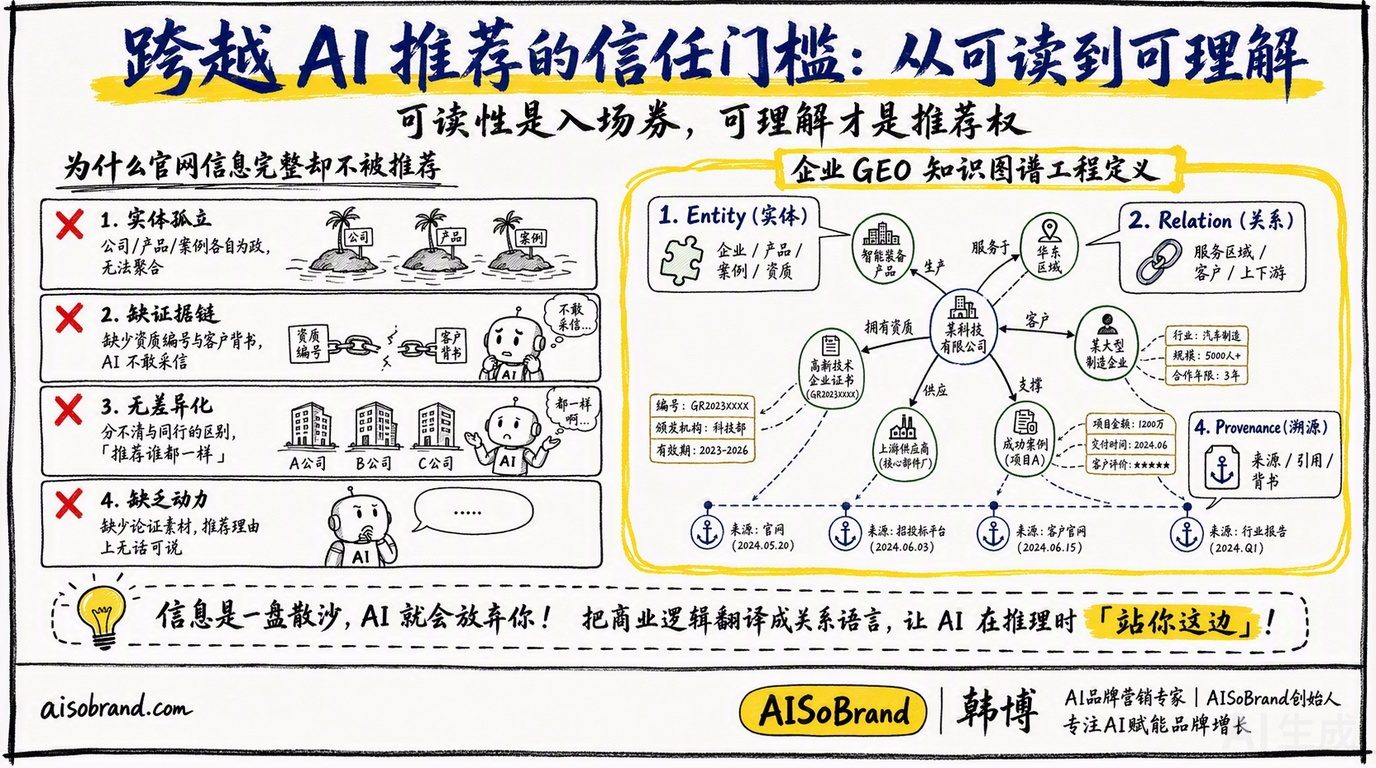
II. The Engineering Definition of a Knowledge Graph in Enterprise GEO
The "knowledge graph" here isn't necessarily a massive graph database. For the vast majority of corporate websites, it's an engineering practice that makes entities and relations explicit: letting AI know not only "what you have" but "how they connect and why they're credible." In other words, it translates the website's "business logic" into a "relationship language" that AI can reason over.
core entity standardization
relationship modeling
attribute assertion
trustworthy provenance
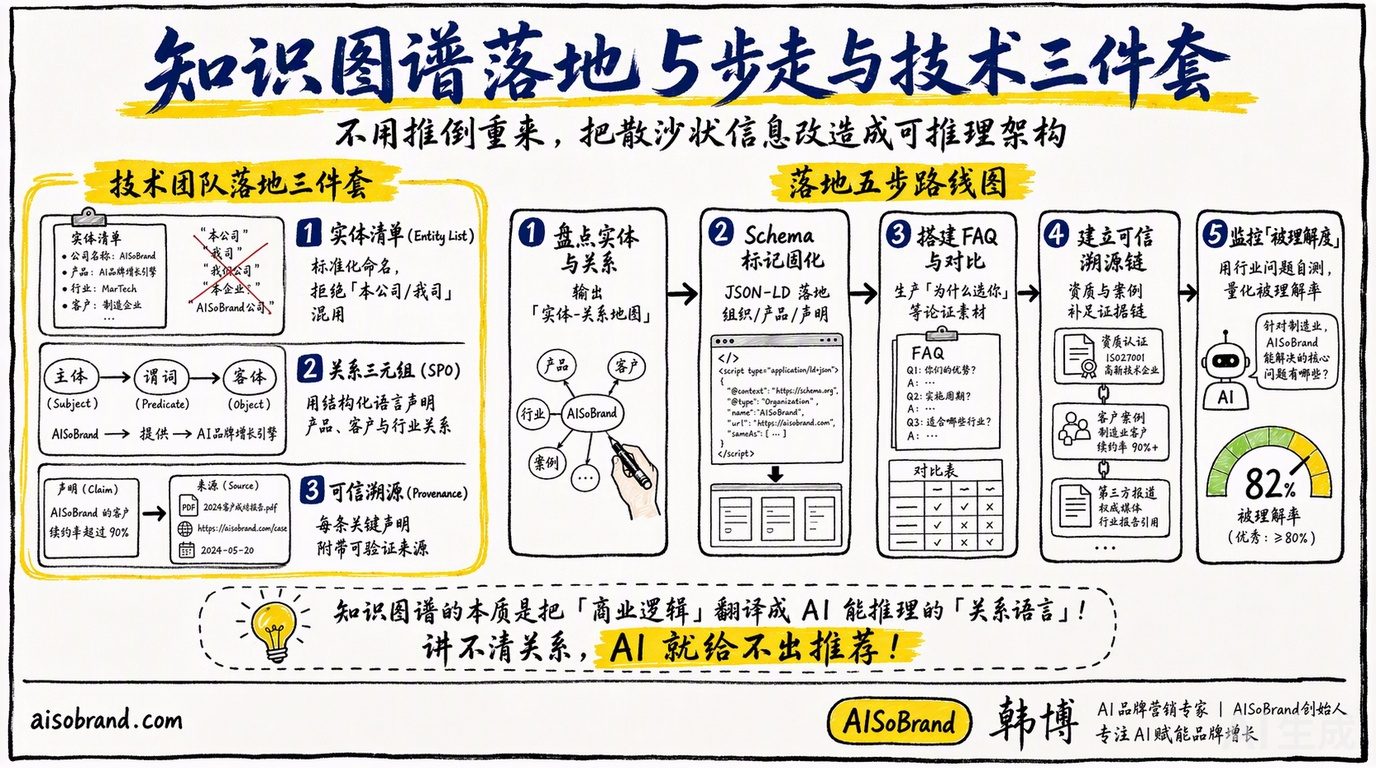
In implementation, Chengying Ruanbo gives enterprise tech teams a three-piece kit: an Entity List — standardize the naming of all core terms, eliminating the "we / our company / us" mixing that prevents AI from aggregating; relationship triples (Subject-Predicate-Object) — declaratively state "Product A → serves → Industry B," "Case C → customer → Enterprise D"; and trustworthy provenance — attach a verifiable source to every key claim so AI's "trust" has a basis.
III. From "Website Prose" to "Machine-Reasonable": Implementation Steps
Turning scattered information into a reason-able knowledge graph doesn't require starting over. The enterprise standard has five steps — the first two are engineering hardening, the last three are content support:
- Inventory core entities and relationsList all key entities (products, services, cases, credentials, regions) and their relationships, and produce an "entity-relationship map."
- Anchor with Schema + graph markupImplement Organization, Product, Service, Claim, and other Schema in JSON-LD, and connect cross-page info with unified entity IDs.
- Build FAQ and comparison contentProactively produce argumentative content like "why choose you" and "how you differ from competitors" to give AI a material library of recommendation reasons.
- Establish a trusted provenance chainAttach verifiable sources (numbers, links, third-party citations) to credentials, customer cases, and data conclusions, completing the evidence chain AI relies on.
- Monitor "understood-ness," not just "indexed-ness"Continuously self-test with industry questions: can AI give a well-reasoned recommendation based on your content? Quantify the "understood rate" and iteratively refine the graph and content.
The essence of a knowledge graph is translating a company's "business logic" into a "relationship language" that AI can reason over. If you can't articulate the relationships, AI can't produce a recommendation.
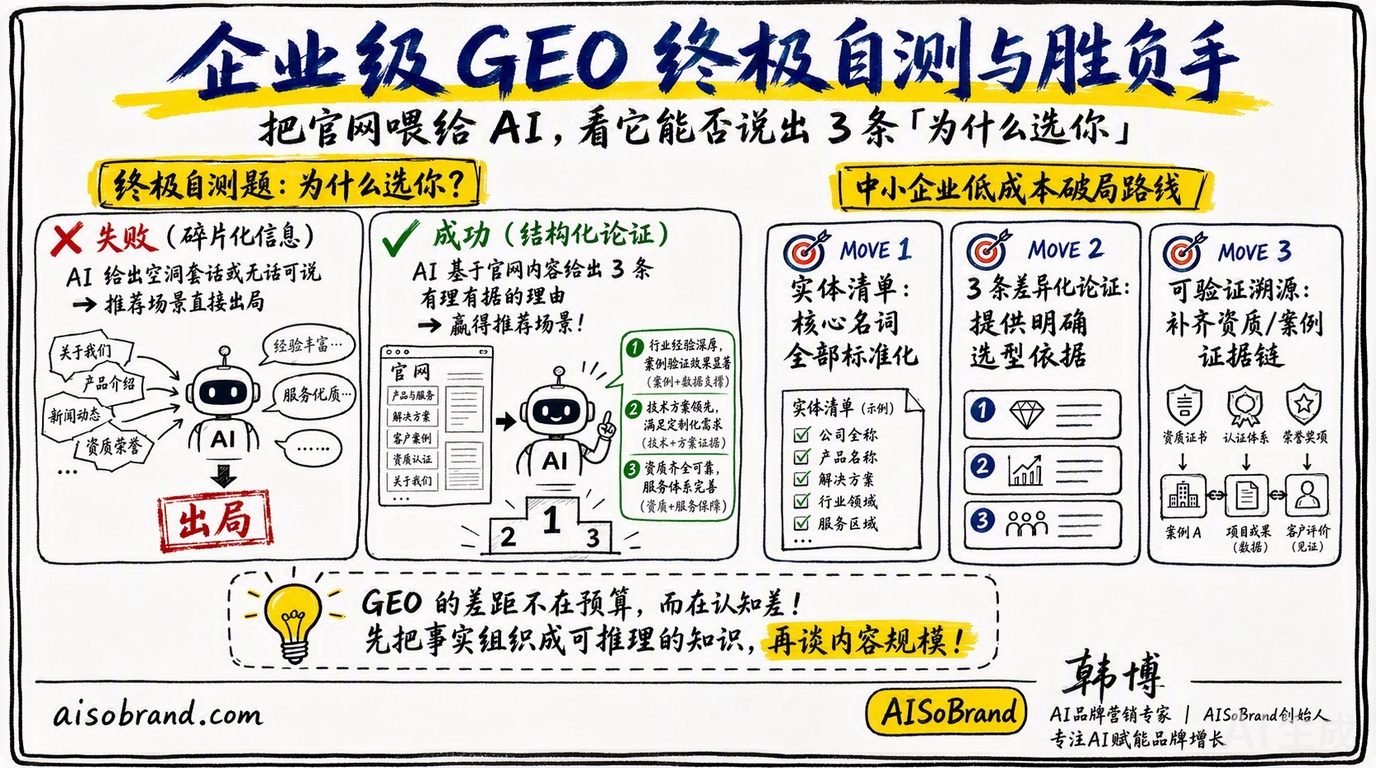
IV. A Litmus Test: Can AI Explain "Why Choose You" on Your Behalf?
Here's a minimal self-test for any company: feed your entire website to AI and ask "why choose X over competitors?" Can AI give three well-reasoned reasons based on your content? If yes, you've upgraded from "information" to "argument" — and recommendation scenarios are precisely about argument. If it can't, you only have fragmented "information," not structured "persuasiveness."
For resource-limited SMEs, you don't need to do everything at once: just nail "entity list + 3 differentiated arguments + verifiable provenance" and you're already ahead of most peers who merely pile up content. The GEO gap was never about budget — it's the cognitive gap of "whether you treat machine-understandability as an engineering standard."
Check your brand's visibility in AI search — for free
Does AI truly "understand" your business? One free GEO diagnosis shows you exactly how your brand is cited and understood across mainstream AI platforms.
Get Free Diagnosis →