The Hidden Barrier Behind Chain Brand Scaling: A Standardized Execution System
In serving chain brands, Chengying Ruanbo has observed a pattern: franchise expansion is not about replicating a financial model — it is about replicating an execution system. Brands that reliably run 500 stores don't succeed because their standards are well written; they succeed because those standards are executed consistently and without drift in every single store. When the execution system can't keep pace with expansion, more stores only means faster brand erosion.
I. The Overlooked Enterprise Challenge: Expansion ≠ Standardization
The standardization dilemma facing chain brands is an underestimated enterprise-level problem.
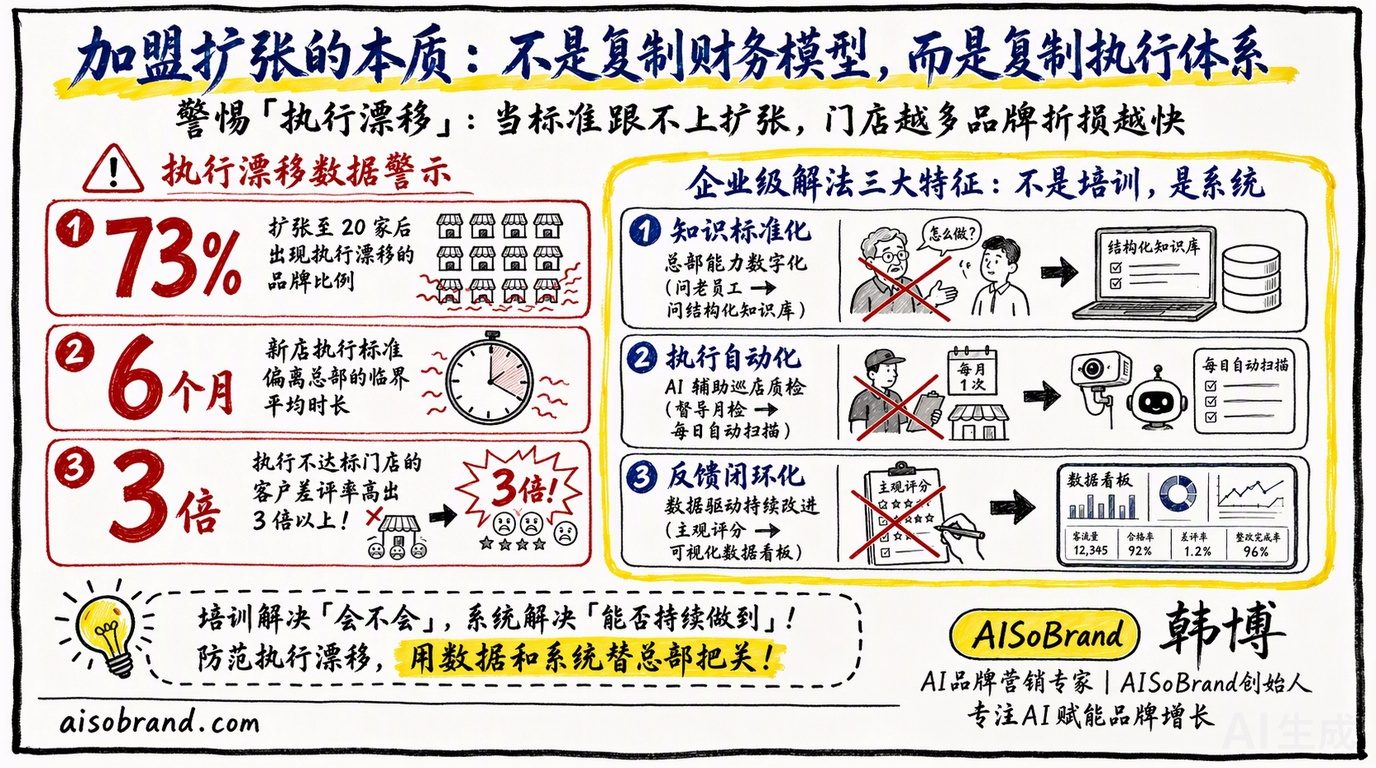
We usually think of "standardization" as SOP documents, operation manuals, and training materials. But in day-to-day operations, the enemy of standardization isn't "no standards" — it's execution drift: in every store, headquarters' standards are gradually diluted through differences in staff, region, management intensity, and individual interpretation.
The cost of execution drift is hidden: it never appears as a separate line item, yet it quietly erodes profit through falling brand reputation, declining customer satisfaction, and rising HQ supervision costs. Chain-brand decision-makers often only realize the problem after the brand is damaged — by which point the cost of correction is already high.
II. The Enterprise Solution for Standardized Execution: Not Training, but a System
Facing execution drift, most brands' instinct is to intensify training. That's the right direction, but not enough.
Training solves the "can they do it" problem, but the root of execution drift is usually "will they" and "can they keep doing it." A store manager trained intensively in the two weeks before opening may still drift from standard six months later due to staff turnover and uneven regional management. That isn't a training-quality issue — it's a design flaw in the standardized execution system.
Chengying Ruanbo believes an enterprise-grade standardized execution system must have three core characteristics:
- Knowledge standardization: digitizing HQ capabilitiesTurn brand standards, operating procedures, and response scripts into a queryable, searchable structured knowledge base. When store staff hit any question, they ask the "knowledge base" instead of a "veteran employee" — ensuring every answer is the headquarters standard, not personal experience.
- Execution automation: AI-assisted, not manually policedUse an AI system to assist store walks, quality checks, and compliance inspections, rather than relying solely on supervisor spot-checks. AI can automatically grade on-site photos and videos uploaded by stores, raising the problem-detection frequency from "monthly supervisor checks" to "daily automated scanning."
- Closed-loop feedback: data-driven continuous improvementEach store's execution compliance rate, problem-type distribution, and remediation completion rate must form a visualized data dashboard. HQ makes decisions on real data, not on supervisors' subjective impressions. Data is the only reliable basis for the continuous improvement of standardization.
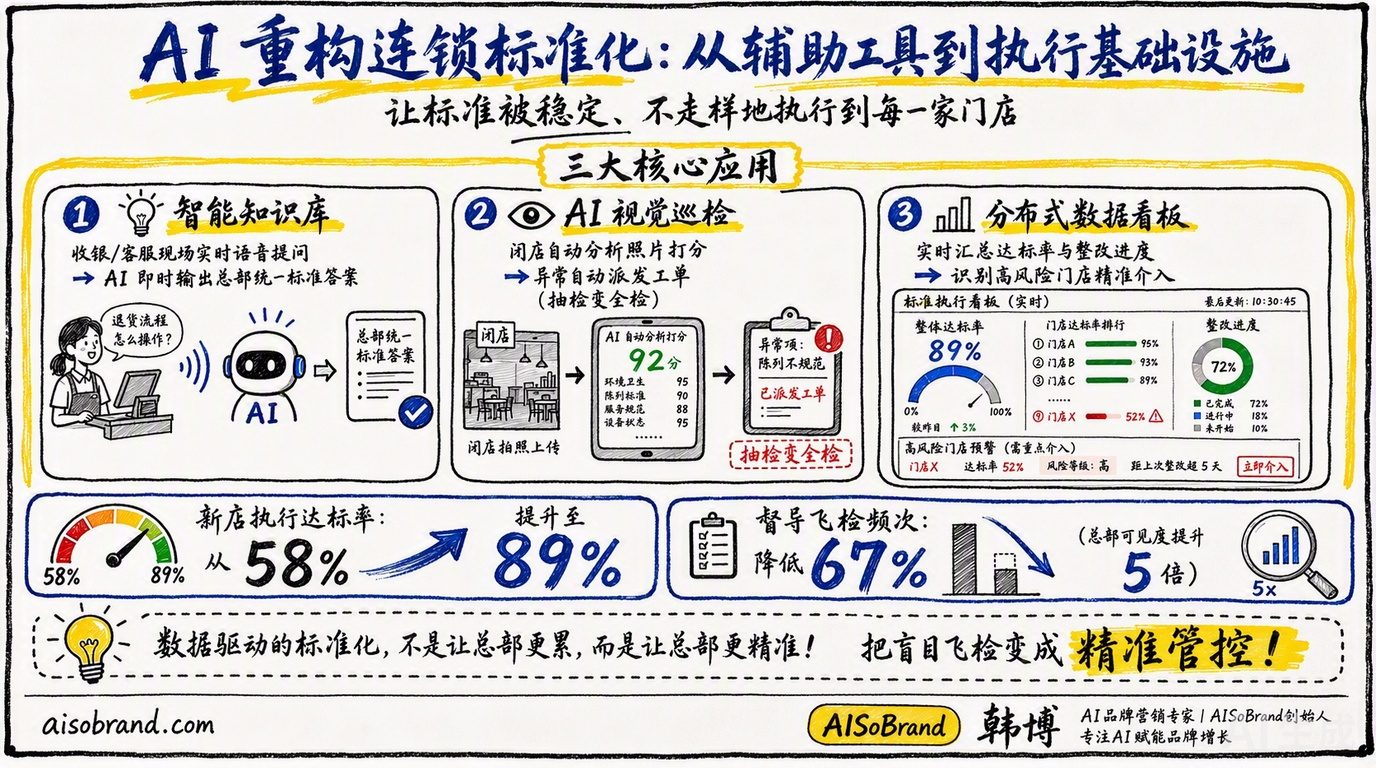
After Chengying Ruanbo built a standardized execution system for a chain brand, new-store compliance rose from 58% to 89%, supervisor spot-check frequency dropped 67%, and HQ's visibility into store operations increased 5x. Data-driven standardization doesn't burden HQ — it makes HQ sharper.
III. How AI Reconstructs the Chain Standardized Execution System
In the field of standardized execution, the value of AI is evolving from "assistive tool" to "execution infrastructure." Here are three application directions with the greatest enterprise value:
1. Intelligent Knowledge Base: Turning "Standards" into Executable AI Responses
The limitation of a traditional knowledge base is that it requires people to actively look things up — yet store staff in real-world situations rarely stop to consult a manual.
The value of an AI knowledge base lies in proactive responses: when staff hit a problem at the register or in a service scenario, they simply ask by voice or text and the AI returns the standard answer instantly. Crucially, HQ can continuously update the knowledge base, so every store and every employee gets the latest standard answer in real time — no need to wait for the next training cycle.
2. AI Visual Inspection: The Leap from Sampling to Full Inspection
Supervisor spot-checks are fundamentally sampling, and sampling means problems can slip through. AI visual inspection flips this logic entirely: after closing each day, the system automatically analyzes the displays, hygiene, and compliance photos stores upload, scoring each item against the standard template, and auto-generating a remediation ticket for any anomaly and pushing it to the store manager.
From a quality-management perspective, this achieves a qualitative shift in execution standards from "sampling" to "full inspection." Only when every operation in every store is tracked by a standardized system can the source of execution drift truly be sealed off.
3. Distributed Data Dashboard: Making Every Store's Execution Visible
The scarcest capability for a chain brand's HQ is seeing in real time the execution status of every store — not relying on supervisor reports.
A distributed data dashboard consolidates each store's execution compliance, problem distribution, and remediation progress into a single unified view, letting HQ monitor standardization trends weekly, quickly flag "high-risk stores," and intervene precisely. This upgrades supervision from "casting a wide net" to "precise targeting," dramatically improving management efficiency.
The maturity of your execution-system standardization sets the ceiling for a chain brand's expansion. When standards can't be reliably replicated, faster expansion only raises the risk of brand dilution. This isn't an operational detail — it's an enterprise-level strategic choice.
IV. Maturity Self-Check for Your Standardized Execution System
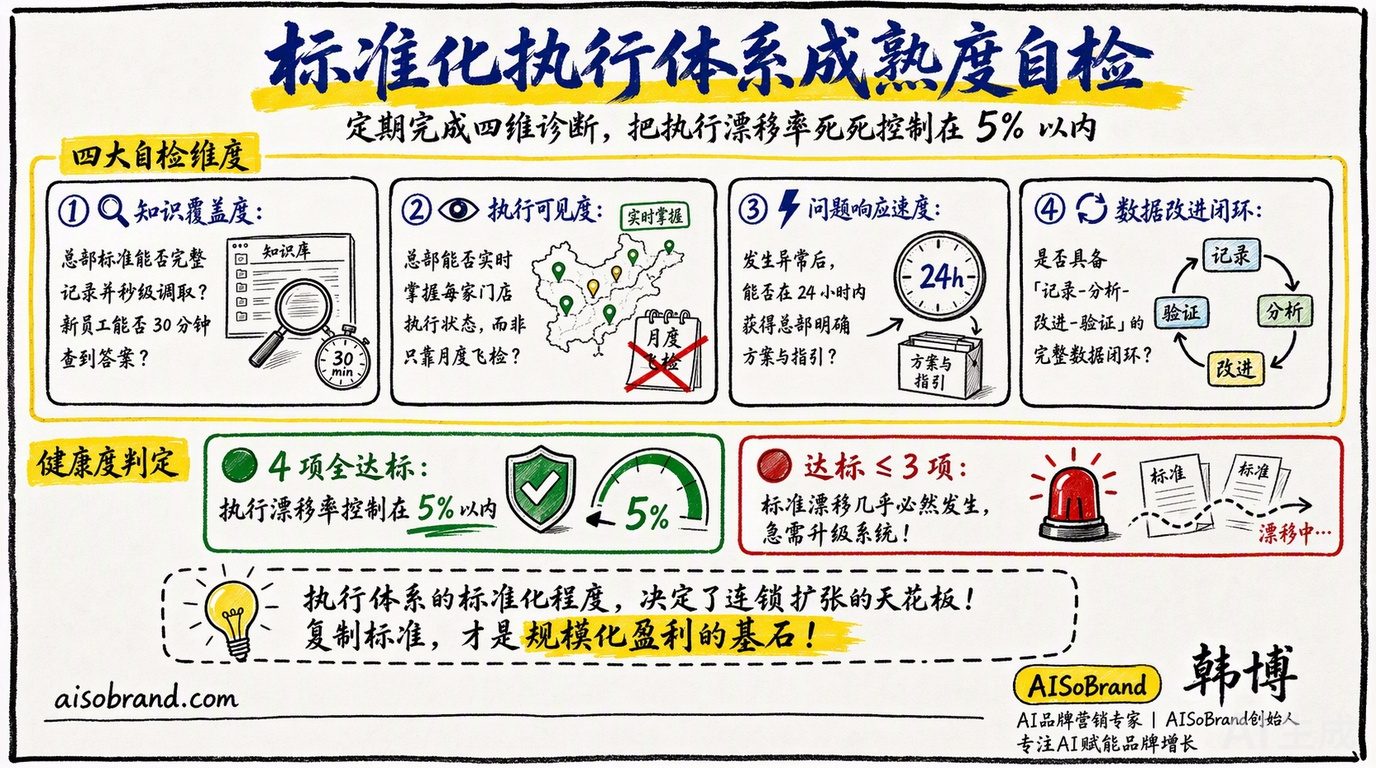
Chengying Ruanbo recommends that every chain brand with scaling ambitions regularly complete a self-check across the following four dimensions:
① Knowledge coverage: Can HQ standards be fully recorded and retrieved at any time? Can a new hire find every standard answer within 30 minutes of onboarding?
② Execution visibility: Can HQ see each store's execution status in real time, or only via monthly supervisor reports?
③ Issue response speed: When a store detects a standards-execution anomaly, can it get clear HQ guidance and a remediation plan within 24 hours?
④ Data improvement loop: Can execution issues form a complete closed loop of data logging, root-cause analysis, improvement plan, and effect verification?
Brands that fully meet all four dimensions can keep execution drift under 5%. For those meeting fewer than three, standards drift is almost inevitable — only a matter of time.
Check your brand's visibility in AI search — for free
A chain brand's growth lives not only offline, but also in AI search. Chengying Ruanbo offers a free brand AI-search presence check covering major platforms such as Doubao, Qianwen, Wenxin, and DeepSeek, helping you understand your brand's visibility and opportunities in the AI era.
Get Free Check →