How B2B Companies Can Break Through in AI Search: From "Invisible" to "Recommended"
In 2026, the decision gateway for B2B procurement has changed. More and more procurement managers no longer flip through directories or call companies one by one for price comparisons. Instead, they open Doubao, DeepSeek, or Kimi and ask: "Recommend a few reliable XX suppliers." Is your company in AI's answer?
I have been in brand digitalization for 22 years, helping over a hundred companies with AI search presence diagnostics. One pattern is becoming increasingly clear: the vast majority of mid-sized B2B companies are "invisible" in AI search. Not because they are not good enough, but because they simply do not appear where AI can see them.
01 Why Are B2B Companies More Easily "Forgotten" by AI?
B2B companies and consumer brands face entirely different situations in AI search. Consumer brands have massive volumes of user discussions, e-commerce reviews, and media coverage, making it easy for AI to piece together "what this brand is." But B2B companies have extremely limited information sources: their website, industry directories, and a small amount of news coverage. If the website itself is not AI-friendly, AI literally has "nothing to say."
Breaking it down, mid-sized B2B companies generally face three "invisible walls":
Wall 1: The Website Is a "Storefront for Humans," Not a "Profile for AI"
Hero images, company introductions, product listings — human salespeople can understand these, but AI cannot extract structured capability information: which industries you serve, what credentials you have, what case studies you have done, and what your delivery standards are. When AI reads a five-star hotel website, it can extract "location, star rating, room types, price range"; when it reads a B2B company's website, it usually can only extract "company name + main business + phone number."
Wall 2: Lack of E-E-A-T Authority Signals
E-E-A-T stands for Experience, Expertise, Authoritativeness, and Trustworthiness. Industry media coverage, association certifications, professional content output — AI relies on these signals to determine "whether a company is worth recommending." Most mid-sized B2B companies have almost zero accumulation in this area, so AI cannot find any external authoritative information to verify you, and simply ignores you.
Wall 3: Key Information Hidden Where AI Cannot Reach
Contact information is locked behind a "Contact Us" form, credentials are PDF attachments, and pricing requires filling out a form. AI can read web page text but cannot fill out forms or open PDFs.
📊 Data Confirms
Based on Chengying Ruanbo's survey of 100 mid-sized B2B companies:
- 87% of companies are "invisible" across Doubao, Wenxin, and Kimi
- 92% of websites lack Schema structured data markup
- Only 6% of websites have AI-readable credentials and business capability descriptions
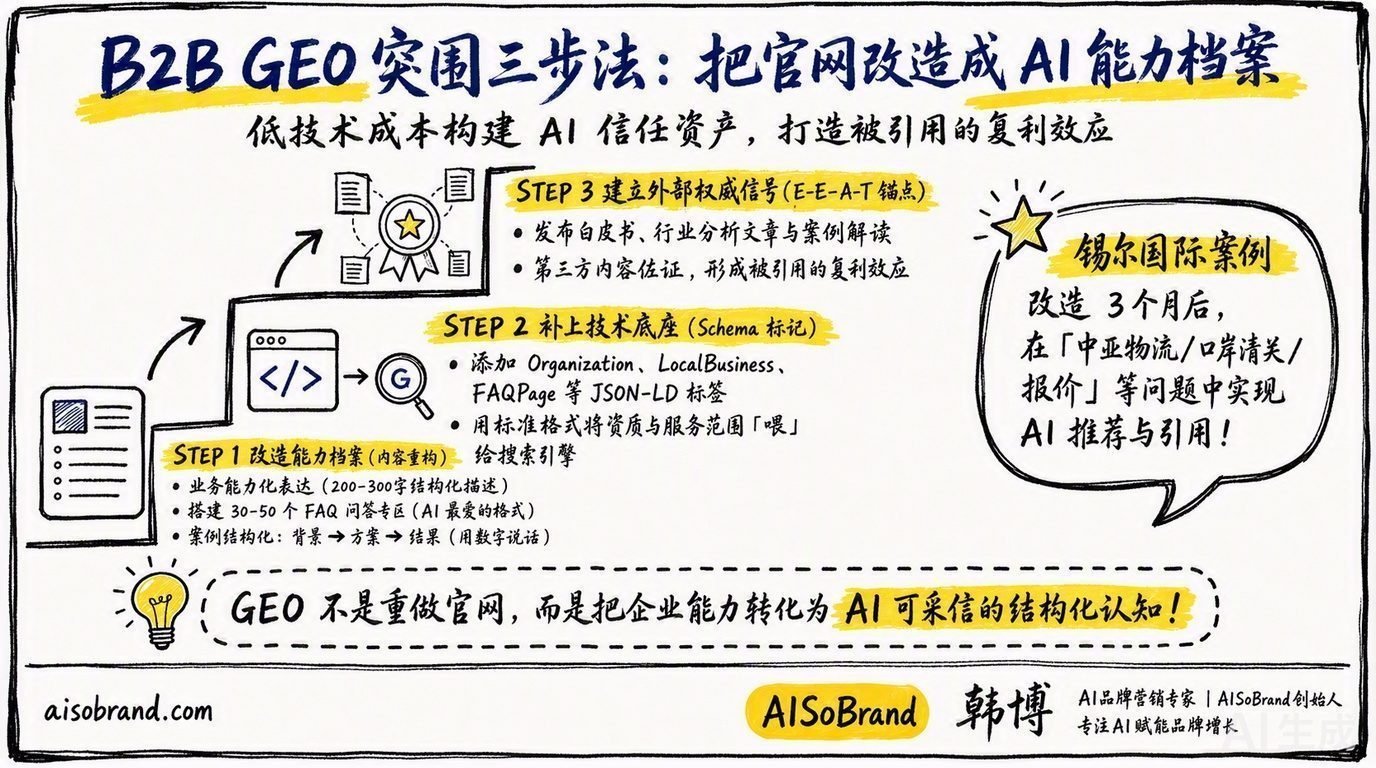
02 From "Invisible" to "Recommended": A Three-Step Breakthrough
Elimination and Evolution: The AI-Era Sales Team Capability Upgrade Matrix
Step 1: Transform Your Website into an "AI-Readable Capability Profile"
No need to rebuild the website — just do three things:
- Capability rewrite: Express each business unit in "capability language" — what problems you solve, which industries you serve, what credentials and case studies you have, and what your delivery standards are. 200-300 words per business line, structured and verifiable.
- Build an FAQ section: Write the 30-50 most common customer questions as Q&A. This is AI's favorite content format and the most easily cited type of content.
- Structured case studies: Background → Solution → Results, with data to back it up, so AI can extract your delivery capabilities.
Step 2: Build the Technical Foundation
Add Schema structured data to the website header (Organization, LocalBusiness, FAQPage, and other JSON-LD markup), feeding search engines company address, credentials, and service scope in a standard format AI can read. The technical cost is minimal, but the improvement in AI friendliness is transformative.
Step 3: Build External Authority Signals
Continuously publish industry analysis articles, solution white papers, and client case study breakdowns to establish content anchors in industry media. When AI searches for "XX industry suppliers," it needs third-party information to verify "this company is worth recommending." The more professional content you produce, the higher the probability AI will cite you — this is the compound effect of GEO.
📌 Real Case: A B2B Logistics Company's Three Months
Take Xier International, a company we served: before the transformation, searching for "Xinjiang Central Asia logistics companies" on Doubao returned nothing about it. Three months after the transformation:
- Asking "Urumqi Central Asia logistics companies" → appeared in the recommendation list
- Asking "which Khorgos port customs clearance is reliable" → AI began citing content from its website
- Asking "Central Asia transport quotes" → AI provided its website contact information as a reference
From "invisible" to "AI can articulate what this company does and what its advantages are" — for a B2B company, this is already a massive trust asset.
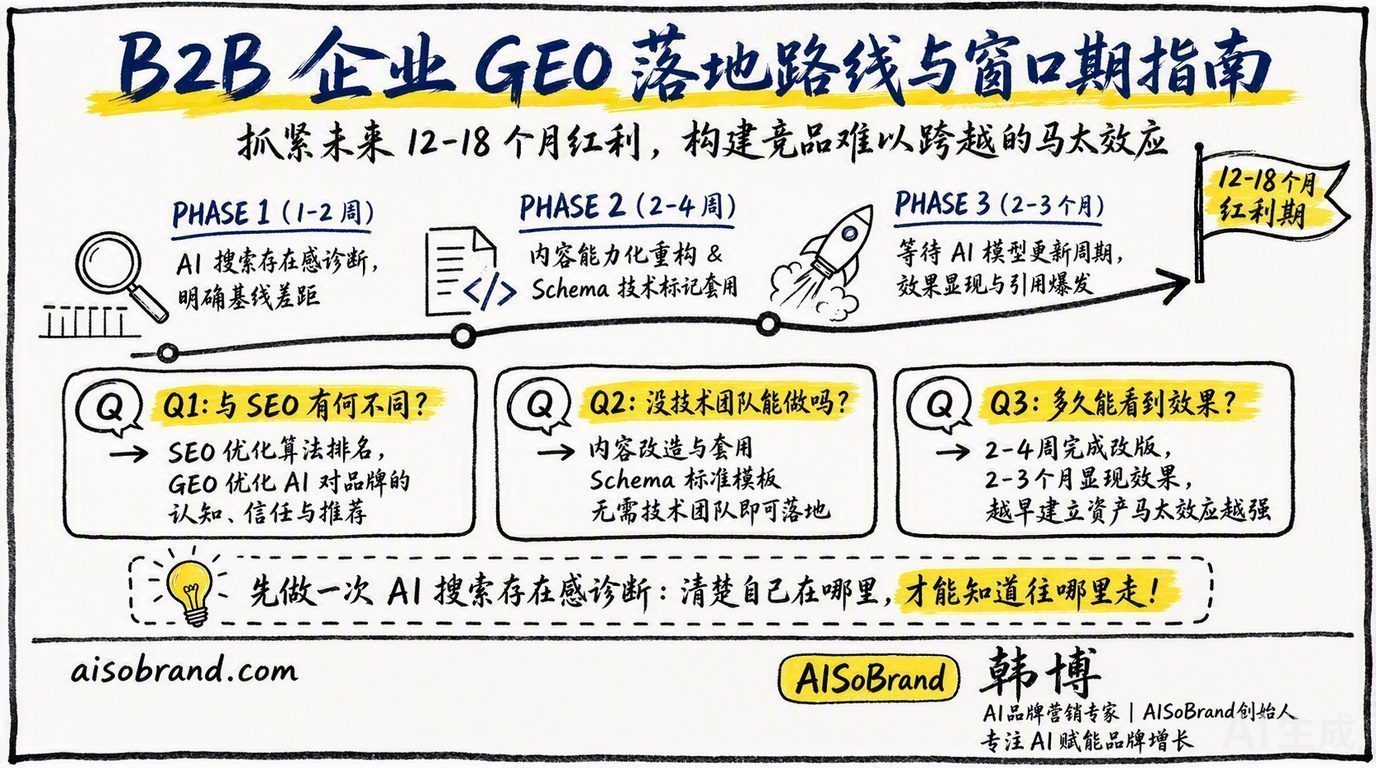
03 The Window Is 12-18 Months
The logic of B2B marketing is being reconstructed. In the past, it was "rank well on Baidu → wait for customers to come to you"; now it is "make AI recommend you at key moments → customers proactively reach out." The traffic dividend window for AI search is 12-18 months. Content assets and AI citation records built by first movers will create an increasingly strong Matthew effect — the more you are cited, the more likely you are to be recommended.
For all mid-sized B2B companies, my advice is: do not wait. Get an AI search presence diagnosis first to see where you actually rank on platforms like Doubao, DeepSeek, and Kimi, then decide where to start.
Enterprise GEO and Sales Enablement Loop: Dual-Wheel Drive Implementation Map
FAQ
How is your brand performing in AI search?
Chengying Ruanbo offers a free brand AI search presence check, covering major platforms including Doubao, Qianwen, Wenxin, and DeepSeek. Report ready in 3 minutes.
Get Free Diagnosis →